
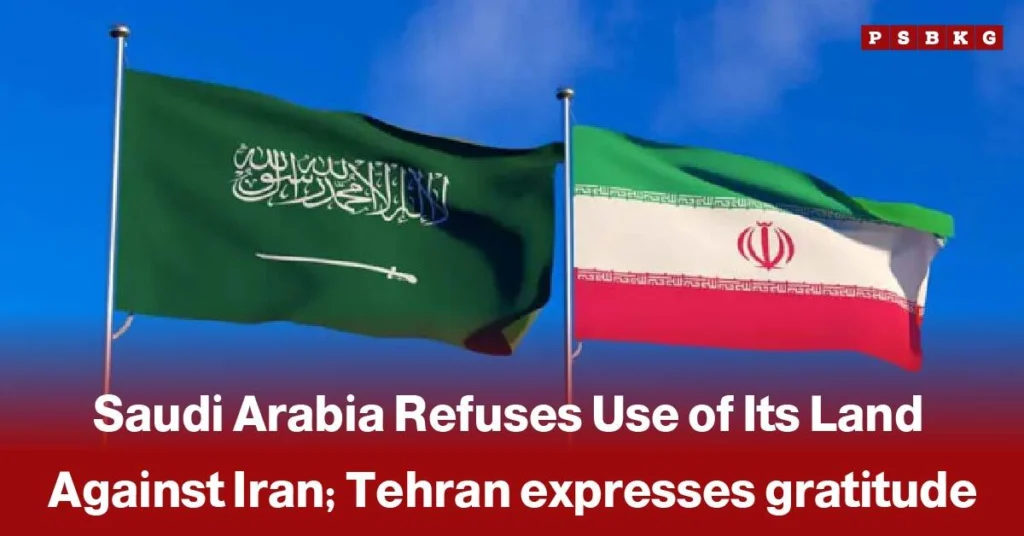
In a notable development in the ongoing Middle East tensions, Saudi Arabia has said it will not allow its territory, airspace, or waters to be used for military action against Iran. The stance was reaffirmed by Riyadh’s leadership as conflict between Iran, the United States, and Israel intensified in recent days. In response, Tehran’s officials publicly thanked Saudi Arabia for this position. The goodwill message marked a rare diplomatic moment amid escalating hostilities. Experts say it reflects Saudi Arabia’s cautious approach to avoid widening the war. The announcement drew attention because the kingdom had previously condemned attacks but still insisted on not becoming a base for action against Tehran.
Riyadh’s Position on Neutral Territory
Saudi leaders have made clear that they respect Iran’s sovereignty and won’t permit their territory to be used in a war against Tehran. Crown Prince Mohammed bin Salman reportedly conveyed the message during talks with Iranian officials earlier in the crisis. Riyadh’s statement underlined that its airspace, land, and maritime zones will remain off limits for military operations targeting Iran. This position stands even as tensions with Tehran rise elsewhere in the Gulf. The refusal is meant to keep Saudi Arabia out of direct involvement in the conflict. Many analysts link this stance to the kingdom’s interest in regional stability.
Iran’s Public Thank You
Iran’s ambassador to Saudi Arabia, Alireza Enayati, personally thanked Riyadh for the stand. He told reporters that Tehran appreciates the kingdom’s pledge not to allow its territory to be used against Iran during the ongoing conflict with U.S. and Israeli forces. The gesture was widely reported in both Iranian and international media. It was described as “a principled position” that Iran values, especially since hostilities have struck neighbouring countries and escalated rapidly. Tehran’s expression of gratitude stood out amid otherwise harsh rhetoric from both sides.
Why It Matters Now
The Middle East is on edge as military actions continue around and inside Iranian territory. Many nations neighbouring the conflict fear spillover if airspace and land routes are used for attacks. Saudi Arabia’s refusal to allow such use signals a desire to avoid expansion of the fighting. It also helps explain why parts of the conflict have remained constrained within certain borders so far. Diplomats see this as a move to limit wider regional involvement. The message resonates beyond just two governments — the stance affects military planning and alliances.
Riyadh’s Balancing Act
Saudi Arabia has repeatedly condemned attacks on its soil — including drone strikes and incidents near diplomatic missions — but insists on defending its own territory and citizens. Riyadh’s government argues that it has the right to protect itself while avoiding actions that could drag it into a broader war. Authorities have made clear they will still take necessary defensive measures if they face direct threats, but they won’t provide logistical support for attacks on Iran from their land or airspace.
The Broader Regional Context
The Saudi position reflects a wider pattern of regional actors trying to balance support and caution. Many Gulf states have avoided direct confrontation even as they condemn hostile actions. Leaders in the region have emphasised dialogue and stability over escalation. The refusal to allow territory use against Iran fits within this broader strategy, which is focused on preventing further destabilisation of the Gulf. Analysts say the kingdom is seeking to uphold its sovereignty while avoiding entanglement in a full‑scale regional war.
Tehran’s Diplomatic Message
Iran’s gratitude is also a diplomatic signal, showing that even in conflict, there are lines both sides acknowledge. Tehran’s public thanks may be aimed at preserving channels of communication and reducing the risk of miscalculation. Iranian officials have reiterated their emphasis on sovereignty and resistance, but they have also shown appreciation when neighbours choose restraint. The message is being interpreted as part of Iran’s broader effort to rally regional support or at least avoid further adversarial alignments.
What This Means for Conflict Dynamics
Saudi Arabia’s decision is significant because it potentially limits one broader front in a conflict that could otherwise expand quickly. Military planners in Washington, Riyadh, Tehran, and settler governments are all watching regional moves closely. With Saudi land and airspace off limits for action against Iran, any future strikes may have to rely on other corridors. This could affect timing, logistics, and international diplomacy efforts to dial down tensions.
Looking Ahead
Both sides now appear to be managing the conflict with careful messaging as well as military posturing. Saudi Arabia’s refusal and Iran’s acknowledgment may open space for further diplomatic engagement, or at least de‑escalation efforts. Global powers have repeatedly called for restraint, and this development could support such calls. The coming days are likely to show whether this position holds as hostilities continue. For now, Riyadh’s stance represents a rare point of relative calm in an otherwise volatile situation.