

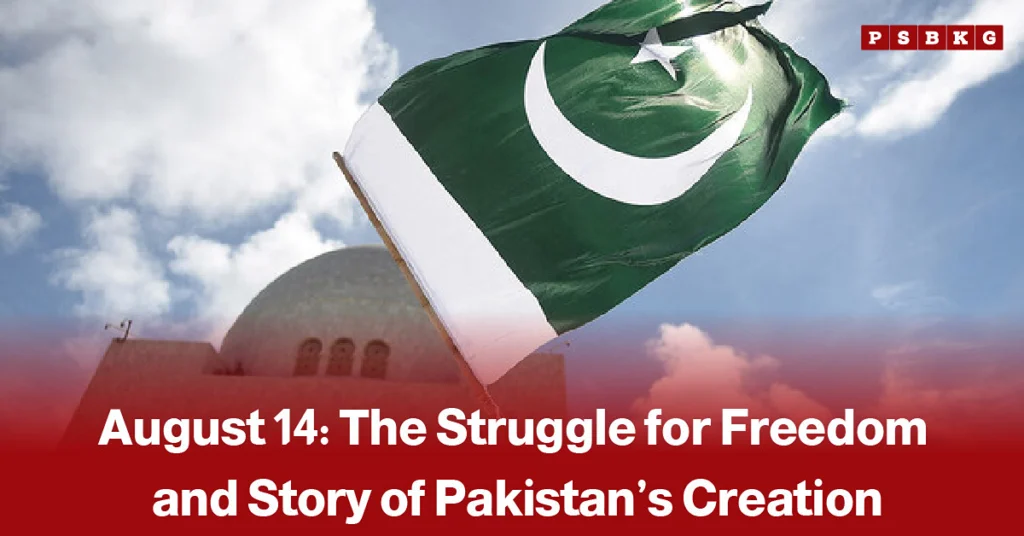
A Day That Changed History
August 14 is more than a date on Pakistan’s calendar. Every year, the day brings back memories of a long political struggle, difficult decisions, sacrifices, and the hope of millions who wanted a separate homeland. In 1947, that dream became a reality when Pakistan emerged as an independent country. The journey, however, had not been simple.
The Demand for a Separate Homeland
The idea of a separate homeland for Muslims of the subcontinent gained political strength during the early decades of the 20th century. Muslims feared that their political, cultural, and social interests could be overshadowed in a united India. The All India Muslim League gradually became the main political platform representing these concerns. Under the leadership of Muhammad Ali Jinnah, the demand for greater political safeguards eventually developed into a call for a separate state.
The Lahore Resolution Became a Turning Point
One of the most important moments came in March 1940, when the Muslim League held its historic session in Lahore. The Lahore Resolution called for independent states in Muslim majority areas of the subcontinent. The resolution did not immediately create Pakistan, but it gave the political movement a clearer direction. In the years that followed, the demand for a separate homeland became increasingly central to Muslim politics.
Jinnah and the Struggle for Pakistan
Muhammad Ali Jinnah played a central role in turning the demand into a powerful political movement. Known for his legal background and constitutional approach, Jinnah continued negotiations with British authorities and Indian political leaders. His message of political representation and Muslim rights attracted growing support. The 1945 and 1946 elections further strengthened the Muslim League’s position in Muslim majority areas.
Partition Brought Both Hope and Pain
The creation of Pakistan was accompanied by one of the largest migrations in modern history. Millions of Muslims, Hindus, and Sikhs crossed the newly created borders, leaving behind homes, businesses, and communities. The migration was also marked by terrible violence and loss of life. For many families, independence therefore remains a memory that combines celebration with grief and sacrifice.
Pakistan Emerges on August 14
Pakistan became independent on August 14, 1947, with Muhammad Ali Jinnah becoming the country’s first Governor General. The new nation faced enormous challenges from its very beginning. There were millions of refugees to settle, limited administrative resources, and the difficult task of establishing institutions for a country that had only just come into existence.
The Meaning of Independence Today
More than seven decades later, August 14 continues to hold a special place in the hearts of Pakistanis. Streets and homes are decorated with national flags, while schools, offices, and communities organise celebrations. But Independence Day also offers a chance to remember the difficult journey that made the country possible. The story is not only about celebration, it is about understanding the sacrifices behind the creation of Pakistan.
Remembering the Journey
Pakistan’s creation was shaped by political struggle, negotiations, public mobilisation, and enormous human sacrifice. The events of 1947 changed the map of South Asia and created a country that would go on to develop its own identity and institutions. As Pakistan celebrates another Independence Day, the history of August 14 remains a reminder of where the country came from, and of the hopes that surrounded its birth.