

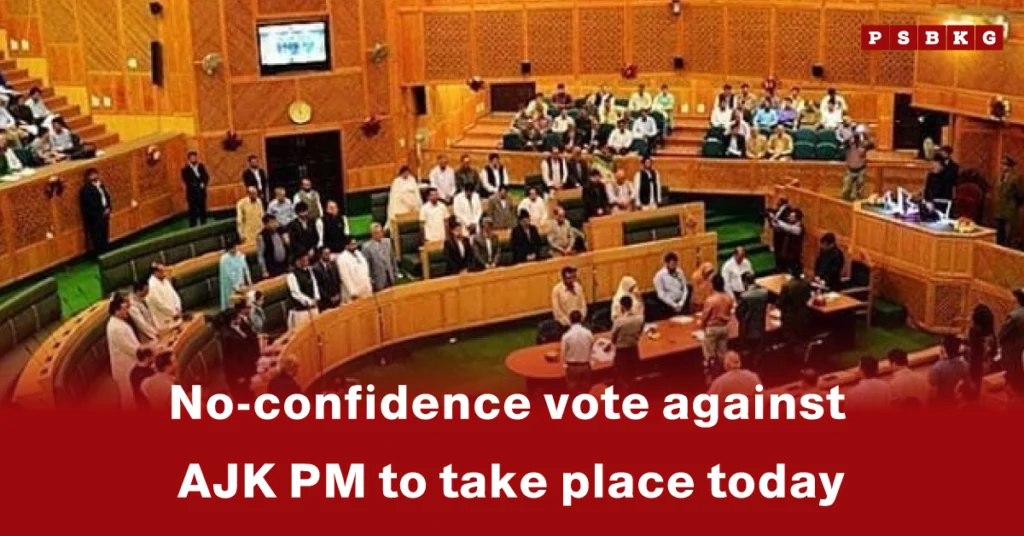
A tense day in AJK politics
Latest News: Politicians in Azad Jammu and Kashmir woke up today with a sense of tension in the air. The legislative assembly is preparing to vote on the AJK no-confidence vote against the Prime Minister of AJK, a moment that could shift the political landscape overnight. Lawmakers, party leaders, and supporters are watching closely. Even early in the morning, conversations across Muzaffarabad felt heavier than usual, as if everyone understood how important the next few hours would be.
These motions are never just paperwork. They carry emotion, ambition, disappointment, and power. And today’s AJK no-confidence vote has all of that wrapped into one complicated day for AJK’s political scene.
How this political storm began
The motion didn’t appear suddenly. It grew slowly, through weeks of disagreements and internal resistance. Some lawmakers felt the government wasn’t moving in the direction they wanted. Others believed the leadership had become disconnected from the issues on the ground. Different voices came together, and eventually, the AJK no-confidence vote arrived on the assembly’s desk.
Political insiders say this was expected. Quiet whispers in party meetings had hinted at it for weeks. But the moment the AJK no-confidence vote became official, the atmosphere changed. The Prime Minister’s supporters pushed back, calling it unnecessary, while critics described it as overdue.
Parties weighing their options
No-confidence votes are moments when political alliances truly reveal themselves. Parties spend long hours negotiating, persuading, and sometimes trying to bring old friends back into their corner. Reports say that both sides held late-night meetings ahead of the AJK no-confidence vote, trying to secure numbers for or against the motion.
For lawmakers, the AJK no-confidence vote is more than a choice. It’s a decision about the future of their careers and the direction of the region. Some may remain loyal to the Prime Minister, while others might feel the political tide pushing them toward change. Such calculations always carry risks, and today everyone will see who stands where.
The PM’s camp pushing to stay in control
The Prime Minister’s supporters have spent the last few days trying to strengthen their position ahead of the AJK no-confidence vote. They’ve argued that the government needs stability, not political confrontation, and believe the PM deserves time to complete policies already in progress.
Inside the camp, there’s a mix of confidence and caution. Confidence because they still trust their numbers. Caution because political moods can shift quickly, especially on the day of the AJK no-confidence vote. A single switch in support can change the entire outcome. That’s why the ruling side remained active until the last hour, making phone calls and arranging meetings.
Opposition hoping for a breakthrough
The groups supporting the motion see this as an important opportunity. They say the region needs fresh leadership and a stronger political direction. Their argument is that the government has not performed effectively and that the assembly must take responsibility ahead of the AJK no-confidence vote.
Opposition leaders sound optimistic but careful. They know victory is possible, but only if every supporting member shows up and votes exactly as planned. Any absence, hesitation, or sudden shift could weaken their chances. This unpredictability is part of what makes the AJK no-confidence vote so dramatic.
People watching with mixed feelings
For citizens, the AJK no-confidence vote brings curiosity mixed with concern. Some hope a change might improve governance, while others worry that political instability could slow down important projects. Traders, civil servants, and young people all share the same question: will this bring progress or just more uncertainty?
In tea shops and on social media, people are discussing possible outcomes of the AJK no-confidence vote. Everyone has an opinion, yet few feel completely confident about what the assembly will decide. That’s the nature of political shifts—they create tension long before any results are announced.
What today’s vote means for AJK
The outcome of the AJK no-confidence vote will shape the political narrative for months. If the motion succeeds, AJK may face a transition period where parties negotiate new leadership. If it fails, the Prime Minister may emerge stronger than before, using the moment to settle internal disputes and rebuild authority.
Either way, the AJK no-confidence vote marks an important moment. It tests political unity, party loyalty, and the strength of leadership. It also sends a message about how lawmakers view the direction of AJK’s governance.
Looking ahead to the final decision