
Introduction
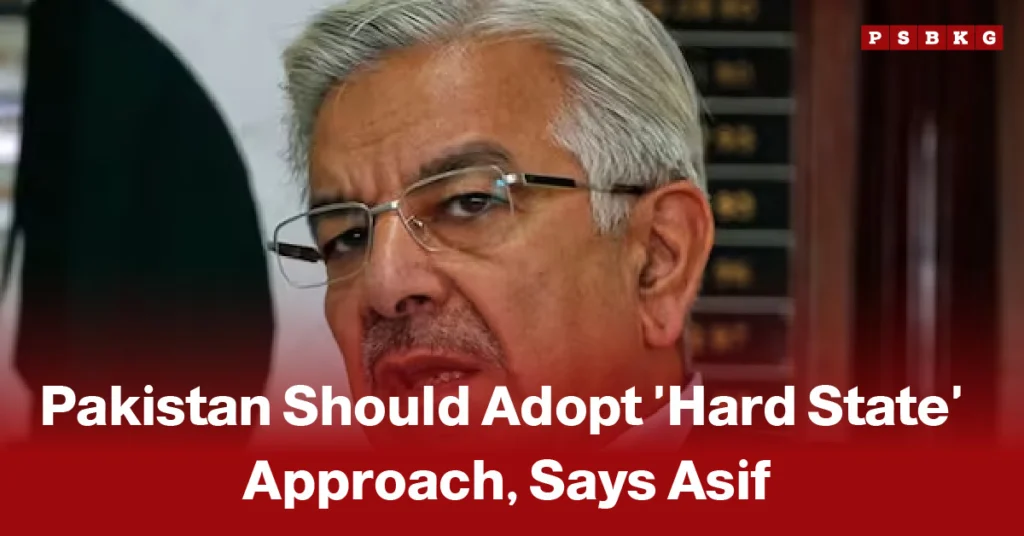
Latest News : The notion that a country must move beyond weak governance to assert firmer control is back in the spotlight in Islamabad. Defence Minister Khawaja Asif recently delivered remarks that stirred public debate: he said that Pakistan must shed its “soft state” image and become a “hard state.” While the phrase “hard state” might conjure heavy-handedness, the underlying message from Asif is about stronger institutions, rule of law and clearer accountability.
What did Asif say?
In his remarks, Khawaja Asif insisted that Pakistan’s longstanding reputation as a “soft state”, a state that lacks effective enforcement of laws, has weak oversight or is unable to assert governance uniformly, must be changed. He suggested that only by embracing a more robust model of governance can the country effectively confront internal and external challenges. He further emphasised that law enforcement must not merely react but proactively uphold state decisions, signalling a shift from symbolic to tangible governance.
Why does this matter now?
In many ways, the remarks tap into broader public sentiment: fears that institutions are not strong enough, that governance is inconsistent, and that security threats exploit weak links in the system. Khawaja Asif call is timely, given a complex regional security context and economic pressures facing Pakistan. Adopting a more assertive posture isn’t only about defence or external threats, it’s about internal cohesion, public trust in institutions, and the credibility of the state. If citizens feel governance is lax, that sense of impunity can erode social contract and stability.
What “hard state” might look like
Of course, “hard state” is a broad term. Asif did not provide a detailed blueprint, but some likely elements can be inferred:
-
Stronger and consistent law enforcement, without selective implementation.
-
Clear chains of accountability for public servants and institutions.
-
More decisive action against terrorism, militancy and organised crime.
-
Streamlined governance where state decisions are carried out rather than simply announced.
-
A shift in perception: both domestically and internationally, that Pakistan is not a passive actor but an active and capable one.
Challenges and Risks
However, there are risks. Adopting a “hard state” approach may raise concerns about over-centralisation, erosion of civil liberties, or institutions becoming too rigid. Balancing firmness with fairness is key. If a government emphasises “hard state” but neglects due process or transparency, it may fuel backlash. There is also the question of how such a posture is operationalised across diverse provincial and local contexts. Additionally, the shift requires capacity: law enforcement must be equipped, trained and trusted. Governance systems must function reliably. Without underlying resources and institutional reform, the label “hard state” can ring hollow.
What people might ask
-
Will this mean greater military involvement in civil governance? Some may worry about blurred lines between civil and security spheres.
-
How will citizens’ rights be protected under a more assertive state model? This is a common concern when “hard state” rhetoric enters public discourse.
-
Will this strengthen federal-provincial coordination or create more friction? Pakistan’s governance is complex, and centralising impulses have implications for provincial autonomy.
-
How quickly will reform happen? Changing perceptions and operations of the state is a long-term endeavour, not a quick fix.
Summary
Khawaja Asif comments add urgency to a conversation about Pakistan’s governance identity. The shift from “soft” to “hard” state is less about brute power and more about credible, consistent, capable state action. Whether this translates into meaningful reforms remains to be seen. For Pakistan, the real test will be whether institutions change and deliver, not simply words. The idea, in short, is that the state must regain the trust of its citizens by being firm, fair and functional. If it does, the label “hard state” won’t be about coercion, but about competence.