
Stylized logo showcasing "Breaking News" in bold red and black text, emphasizing urgency and importance of current events. latest news
Oil Prices Rise Globally After Israeli, US Actions Against Iran Trump Claims US Killed 48 Top Iranian Figures, Destroyed Military Command

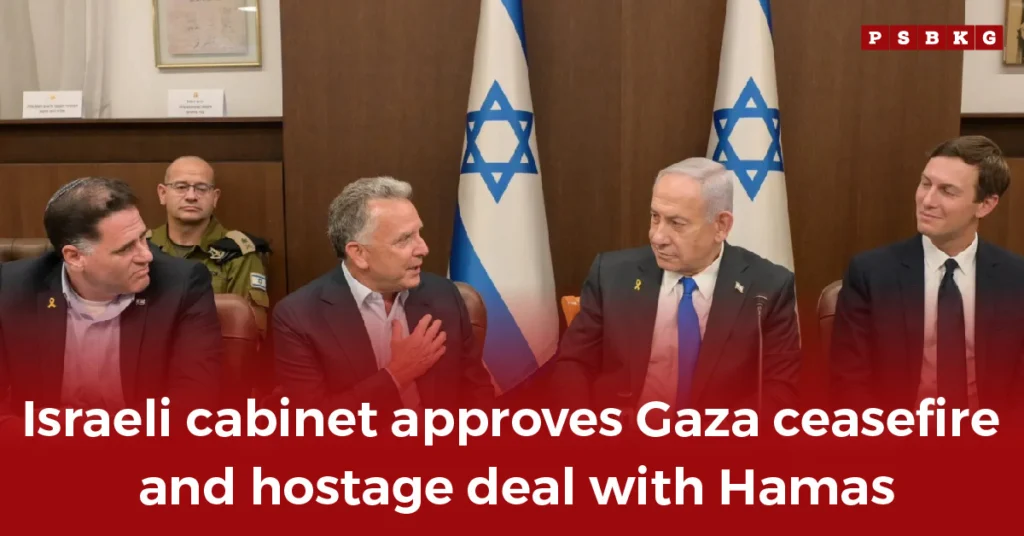
Israeli cabinet approves Gaza ceasefire and hostage deal with Hamas

Israeli officials seated in a cabinet meeting discussing and approving a Gaza ceasefire and hostage deal, with an Israeli flag in the background — Gaza Ceasefire Deal Approve.

Israel Approves Gaza Ceasefire and Hostage Exchange Deal

Latest News : It finally happened. After months of negotiations, tense moments, and quiet diplomatic maneuvers, Israel’s cabinet gave its approval to a Gaza ceasefire deal approve and hostage exchange with Hamas. The decision came after a marathon night of debate, political wrangling, and moral arguments that stretched far beyond politics. For families of the hostages, it was a moment of relief mixed with cautious hope. The deal, reached after weeks of international pressure, marks one of the most significant steps toward ending the latest round of conflict in Gaza. It’s not peace yet, but for many, it’s the first breath after months of holding it.

A Decision Shaped by Pressure and Pain

Inside the cabinet room, the atmosphere was described as tense, emotional, and divided. Some ministers argued that agreeing to the Gaza ceasefire deal approve meant rewarding violence, while others insisted it was the only humane way forward. The faces around the table reflected a country torn between principle and compassion. Outside, families of hostages gathered in the streets, holding pictures of loved ones. Their message was simple: bring them home, whatever it takes. That emotional pressure, combined with international mediation led by Egypt, Qatar, and the United States, eventually tipped the balance in favor of approval. For Prime Minister Benjamin Netanyahu, it was a deeply complex call. On one hand, he faces hardliners who oppose any concession to Hamas. On the other, the public’s demand for action and closure grew impossible to ignore.

What the Deal Actually Includes

The agreement’s first phase centers on two key elements: a temporary ceasefire and the release of hostages held in Gaza, part of the Gaza ceasefire deal approve. In return, Israel is expected to allow more humanitarian aid into the Strip and pause military operations for a specified number of days. Hostage releases will take place in stages. The hope is that as trust builds, both sides might extend the ceasefire or negotiate further terms. Aid trucks are expected to enter Gaza under supervision, carrying food, medicine, and supplies to areas devastated by months of bombardment. It’s a fragile arrangement. But every truce has to start somewhere, and for now, both sides seem willing to test a rare moment of restraint.

The Human Side of the Decision

Behind all the politics and statements are real people, families waiting for news, parents who haven’t slept in months, children wondering if their fathers or mothers will ever come home. In cities across Israel, the news sparked tears and quiet celebrations. Some lit candles, others simply hugged in silence. For them, the Gaza ceasefire deal approve means more than political strategy, it’s a chance to end unbearable uncertainty. In Gaza, too, the announcement brought a moment of hope. People long exhausted by airstrikes and displacement began to talk, quietly, about what peace might look like, even if temporary. Aid workers on the ground called it a critical window to reach civilians cut off from help for weeks.

Reactions Across the Region

International reactions came swiftly. Western leaders welcomed the move as a humanitarian breakthrough. Egypt and Qatar, who played central roles in mediating between Israel and Hamas, hailed it as proof that sustained diplomacy still works, even in the most divided corners of the Middle East. But not everyone is convinced. Some Israeli politicians fear Hamas will exploit the pause to regroup. Others in Gaza question whether Israel will truly stop strikes or if the ceasefire is just another pause before fighting resumes. In a region shaped by cycles of violence and fragile truces, skepticism is inevitable. Still, for the first time in months, there’s a sense of movement however tentative toward de-escalation.

A Small Step, But a Meaningful One

This deal doesn’t end the conflict. It doesn’t solve the political deadlock or heal decades of distrust. But it shows that even amid anger and exhaustion, negotiation is still possible. Analysts say it could become the foundation for broader talks if both sides uphold their commitments. That’s a big if, but in a place where hope has often been a luxury, even small steps matter. For now, the focus is on the coming days ensuring the hostages are released safely, aid reaches those in need, and that the ceasefire holds. The world will be watching closely.


Why This Moment Matters

For the first time in months, there’s a pause, not silence, but something close to it. The kind of pause that lets people breathe, look around, and imagine what peace might feel like again. Both Israel and Gaza have seen enough loss to know that no deal can undo the pain already caused. But if this fragile truce, part of the Gaza ceasefire deal approve, can hold, even briefly, it might open the door for something larger. Diplomacy, compromise, and human empathy, all rare in times of war, have reappeared, however faintly. And that alone makes this ceasefire something worth believing in.

Share With Others

Popular Posts

Advertisement

A promotional graphic featuring a stylish motorcycle helmet, urging riders to protect their heads and wallets with discounts. latest news.

Black Friday

Bold text advertises a "Big Sale" with discounts up to 30% off, set against a soft pastel background. Latest News.

Social Share

Facebook
Twitter
LinkedIn
Pinterest
WhatsApp
A smiling woman with long hair, wearing a pink cap and purple shirt, promotes a 50% off discount on new fashion styles. latest news

Related Articles: