
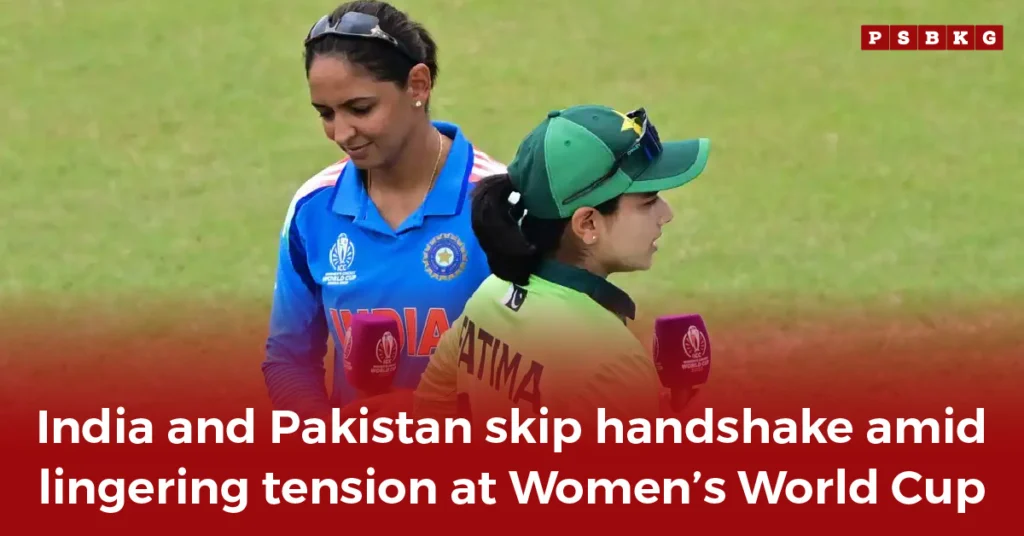
A moment that Spoke Volumes
Latest News : In a match that had fans from both sides holding their breath, a simple gesture, or rather, the lack of it, became the highlight. During the India Pakistan match at the Women’s World Cup, what caught everyone’s attention wasn’t just the scoreline but the missing handshake. After the game ended, the usual tradition of sportsmanship seemed to fade. Players walked past each other with quiet professionalism, no smiles, no clasped hands. For a tournament meant to celebrate unity through sport, it was a moment that reminded everyone of the political tension that continues to shadow India-Pakistan relations.
Cricket Beyond the Boundary
Cricket between these two nations has always carried more weight than most matches. It’s not just about runs and wickets—it’s about pride, history, and sometimes, politics. During the India Pakistan match, the women’s teams, usually more composed and less entangled in off-field drama, found themselves caught in that old web of rivalry. Fans noticed instantly. Social media filled with comments, some disappointed, some defensive. Many argued it wasn’t deliberate, just a tense moment after a tough game. Others saw it as a quiet reflection of how strained relations have become between the two countries, even on the sporting stage.
Lingering Political Backdrop
The absence of a handshake wasn’t born out of thin air. It came against a backdrop of political frostiness that has lasted for years. Diplomatic relations between India and Pakistan remain distant, with dialogue nearly frozen. Even in sports, bilateral series have been suspended, and meetings between cricket boards are rare. For players, these tensions aren’t always personal, but they shape the atmosphere. Every encounter becomes loaded, every expression interpreted, every gesture examined. What might have been an ordinary moment elsewhere turns symbolic when India and Pakistan meet.
Fans Divided Over the Moment
Public reaction has been split, as expected. Some cricket lovers on both sides urged people to move on, reminding everyone that the players are professionals, not politicians. “It’s just a game,” one fan wrote on X (formerly Twitter), “they played hard and that’s what matters.” But others saw deeper meaning. Many called the lack of handshake a reflection of “cold diplomacy on the field,” while some argued that players should rise above political divides. Indian media outlets debated whether it was intentional, while Pakistani commentators described it as “a silent mirror” of the larger political mood. Whatever the intention, the clip went viral within minutes, replayed across news channels and social platforms, analyzed from every angle.
The Pressure on Athletes
For athletes, representing nations with such intense history can be exhausting. Every action is magnified. Every expression becomes a statement. Women cricketers, in particular, have often spoken about the dual pressure, to perform as professionals and to represent their nations’ pride on a politically charged stage. Sources close to the teams said the atmosphere before the India Pakistan match felt “focused but tense.” Coaches briefed players to stay professional and limit interactions, likely as a precaution. Insiders emphasized that it wasn’t hostility, but caution, a desire to avoid anything that might be misinterpreted or taken out of context.
Calls for Perspective
Some sports journalists and peace advocates have urged restraint, saying the focus should remain on the game itself. The Women’s World Cup India Pakistan match is meant to promote equality, teamwork, and respect across borders. While symbolic gestures matter, they argue, the bigger picture is how these players continue to perform under enormous pressure, setting an example of resilience. Both teams, after all, share a passion for the same sport. They train, sacrifice, and compete for the love of cricket, even when politics tries to step onto the field.
Sports diplomacy and what’s next
Experts believe sports diplomacy still holds potential to ease tension, even if small gestures like this cause headlines. History has shown that cricket has sometimes acted as a bridge, famously during the “cricket diplomacy” era when leaders from both sides attended matches together. While the women’s teams didn’t exchange handshakes this time, many hope future tournaments will bring more warmth and interaction. Sports, after all, have a unique power to soften divisions, even the ones carved deep by history. There’s also growing discussion about whether international sports councils should play a greater role in fostering goodwill between rival nations. Encouraging cross-border training programs, youth exchanges, or charity matches could help shift focus back to the spirit of the game.
Closing Thoughts
In the end, the missing handshake during the India Pakistan match between women cricketers wasn’t just a snub, it was a reminder of how complicated the relationship remains. Politics may have drawn the lines, but the players still share the same stage, the same passion, and perhaps even the same silent wish for normalcy. It’s easy to read too much into moments like these, but maybe they also serve as reality checks. Sportsmanship, like diplomacy, takes patience, and sometimes, one small gesture can mean more than a thousand words. The hope is that next time, the focus returns to cricket itself, not the spaces in between.