
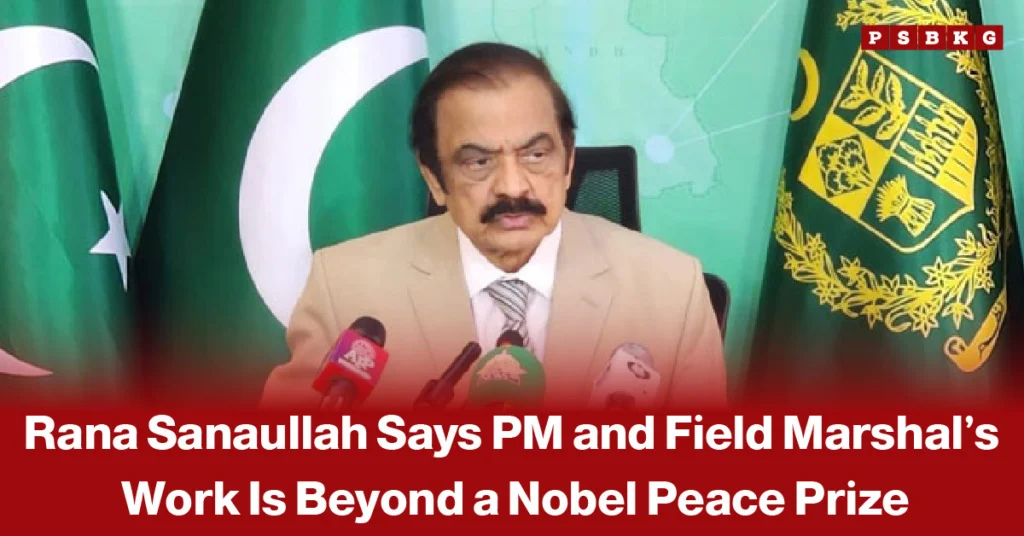
Political adviser Rana Sanaullah said that Prime Minister Shehbaz Sharif and the Field Marshal made efforts to promote regional peace and stability that deserve more recognition than a Nobel Peace Prize can offer. His remarks came while discussing recent diplomatic developments and Pakistan’s role in promoting dialogue during a period of international tensions. The statement has attracted significant public attention, with supporters describing it as recognition of the leadership’s efforts, while others view it as a reflection of the government’s confidence in its diplomatic achievements.
Praise for Leadership
Rana Sanaullah praised both the Prime Minister and the Field Marshal for their role in supporting peace initiatives and encouraging diplomatic engagement. According to him, their efforts have contributed to reducing tensions and creating opportunities for dialogue during difficult circumstances. He said that challenging times often test leadership, and the recent developments demonstrate Pakistan’s commitment to promoting stability through peaceful means.
Focus on Regional Peace
The comments were largely linked to Pakistan’s involvement in diplomatic efforts aimed at easing tensions in the region. Government officials have repeatedly stated that Pakistan supports negotiations and dialogue as the best path toward resolving conflicts. Supporters argue that successful diplomacy often requires patience, coordination, and continuous engagement behind the scenes. These efforts may not always be visible to the public, but they can play a major role in achieving positive outcomes.
Recognition Beyond Awards
While referring to the Nobel Peace Prize, Rana Sanaullah suggested that some contributions to peace are so significant that they cannot be measured by awards alone. He emphasized that the real value lies in preventing conflicts, encouraging understanding, and protecting regional stability. His remarks have sparked debate among political observers, with many discussing the broader role of leadership in shaping international relations and diplomatic success.
Pakistan’s Diplomatic Role
In recent years, Pakistan has sought to strengthen its position as a supporter of dialogue and peaceful conflict resolution. The country has maintained relations with various regional and international stakeholders, allowing it to participate in important diplomatic discussions. Analysts believe that active engagement in regional affairs can enhance Pakistan’s international standing and create opportunities for future cooperation on global issues.
Mixed Reactions to the Statement
The statement has generated a variety of reactions across political circles. Supporters have welcomed the remarks, viewing them as an acknowledgment of efforts made to promote peace and stability. Critics, however, argue that such assessments should be left to history and independent observers. Despite differing opinions, the comments have succeeded in drawing attention to Pakistan’s recent diplomatic activities and the role of its leadership in international affairs.
Importance of Diplomacy in Modern Times
Experts often point out that diplomacy remains one of the most effective tools for preventing conflicts and building long term stability. Successful negotiations can help reduce tensions, strengthen cooperation, and create pathways toward lasting solutions. Today’s political and security challenges require dialogue. Countries that prioritise dialogue often strengthen regional and global peace.
Conclusion
Rana Sanaullah’s statement that the work of Prime Minister Shehbaz Sharif and the Field Marshal is beyond a Nobel Peace Prize has sparked discussion about leadership, diplomacy, and peacebuilding efforts. Whether viewed as political praise or recognition of diplomatic achievements, the remarks highlight the importance of dialogue and cooperation in addressing regional challenges and promoting stability.