
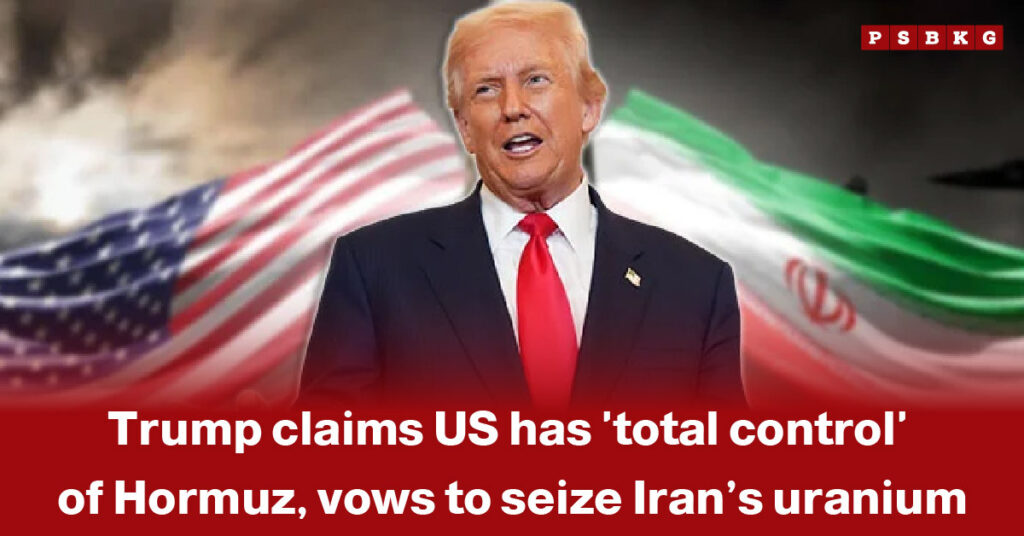
Latest News: Former US President Donald Trump has claimed that the United States has “total control” over the strategic Strait of Hormuz and vowed that Washington will take possession of Iran’s highly enriched uranium stockpile if diplomatic efforts fail to resolve ongoing tensions, and Trump controls Hormuz Strait.
Strong Statement on Strait of Hormuz Control
According to Trump’s remarks, the US maintains complete operational control over the Strait of Hormuz, a critical global oil shipping route. He suggested that American naval presence is strong enough to regulate or restrict movement through the waterway amid rising regional tensions. The claim comes at a time when the Strait remains one of the most sensitive geopolitical chokepoints in the world, with any disruption capable of impacting global energy supplies.
Vow to Seize Iran’s Uranium Stockpile
Trump also reiterated his hardline stance on Iran’s nuclear program, stating that the US will “get” Iran’s highly enriched uranium and prevent Tehran from retaining it under any future agreement. He added that the material would likely be destroyed after recovery, emphasizing that Iran must not be allowed to develop nuclear weapons capability under any circumstances.
Nuclear Tensions Remain Central Issue
The dispute over Iran’s nuclear stockpile continues to be the central issue in US-Iran tensions. Washington has repeatedly demanded strict limits or removal of enriched uranium, while Iran has resisted external control over its nuclear materials. Recent reports suggest both sides remain deeply divided, despite ongoing diplomatic channels and mediation efforts involving regional actors.
Strategic Importance of the Strait of Hormuz
The Strait of Hormuz is one of the world’s most important energy corridors, with a large share of global oil exports passing through it daily. Any escalation in the region could directly impact international oil prices and global supply chains. Experts warn that military tension in the area could quickly lead to instability in energy markets and increased shipping risks.
Iran’s Position and Regional Reactions
Iran has consistently rejected demands to surrender its enriched uranium stockpile, calling it a matter of national sovereignty and security. Tehran has also warned against any attempt to forcibly seize or remove its nuclear material. Regional and global powers continue to closely monitor the situation, as any escalation could affect broader Middle East stability.
Growing Global Concerns Over Escalation
Analysts say statements like these increase uncertainty in already fragile US-Iran relations. Even if not immediately acted upon, such rhetoric can influence diplomatic negotiations, market reactions, and regional security planning. Energy markets in particular remain sensitive to any signals of potential conflict in the Gulf region.
Outlook Remains Uncertain
While diplomatic efforts are still reportedly ongoing in the background, the situation remains highly unpredictable. Experts believe that future developments will depend on whether negotiations can reduce tensions or whether hardline positions lead to further escalation.