
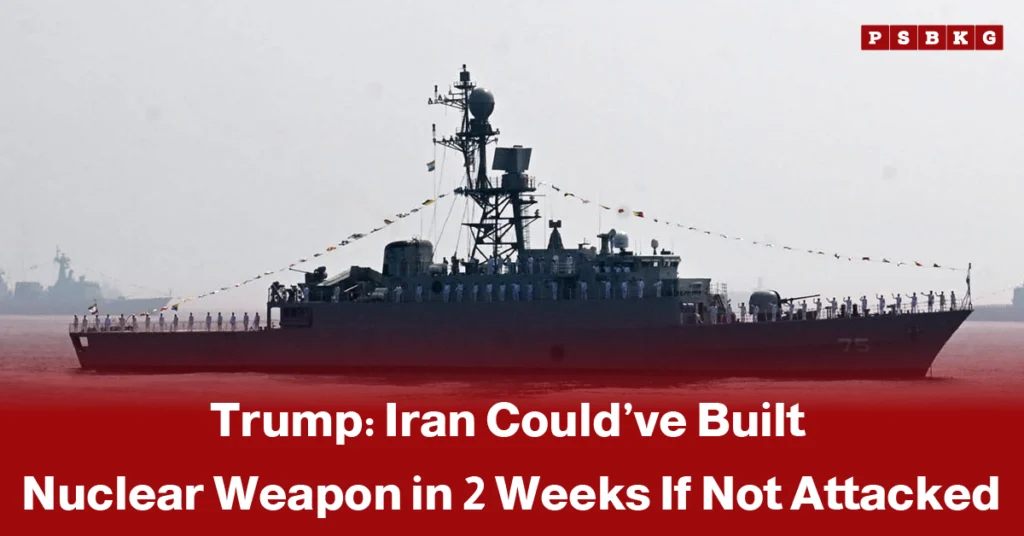
Latest News: U.S. President Donald Trump made a striking statement about Iran’s nuclear program, saying that Trump Claims Iran Nuclear could have produced a weapon in as little as two weeks if the U.S. and its allies had not struck Iranian facilities. He used this argument to justify the ongoing military offensive against Iran’s nuclear infrastructure and military targets. Trump described the action as a pre‑emptive measure to prevent a dangerous new chapter in the Middle East. His comments have quickly drawn attention from media, analysts, and foreign governments alike.
Trump’s Justification for Military Action
What Analysts Say
Iran’s Nuclear Programme Reality
Past U.S. intelligence assessments have suggested a range of scenarios for how long it would take Iran to weaponise its nuclear materials if it chose to do so. In earlier reports, estimates put the time at several months, not mere weeks, depending on enrichment and technical capability. Some confidential assessments indicated a timeframe of weeks to months in the absence of damage to facilities, but did not confirm an active weapons effort.
Context of Recent Attacks
The military operations Trump cited include airstrikes on nuclear sites and other facilities, carried out jointly with allies. These strikes were said to have aimed at disrupting Iran’s capability to produce a bomb and reduce perceived threats from ballistic missiles. Trump has repeatedly linked the military offensive to stopping Iran’s nuclear ambitions and other destabilising activities.
Critics Push Back
Critics of Trump’s comments argue that assertions about Iran being “two weeks away” from a bomb lack solid evidence. They point to the IAEA’s repeated findings that there was no confirmed weaponisation programme and stress that intelligence estimates vary widely. Some observers say such claims are being used to justify military escalation. Others say setting arbitrary timelines can be misleading and politically driven.
Regional Reactions
Middle East governments and international organisations have reacted with a mix of concern and caution. Some countries have called for de‑escalation and a return to diplomacy, warning that war rhetoric could spiral into broader conflict. Others have echoed the need to prevent nuclear proliferation, but stress that actions should follow international law and verification. The debate continues at the United Nations and in global capitals.
Implications for Global Security
If Iran were genuinely close to building a bomb, it would have far‑reaching implications for regional security, non‑proliferation treaties, and global stability. Yet experts warn against overstating timelines, because technical, political, and logistical factors all influence nuclear development. The contrasting narratives political claims versus independent agency reports — show how complex the issue remains.
What Comes Next
As the conflict unfolds, intelligence assessments, diplomatic efforts, and public statements will continue to shape global perception. Trump’s claim about the two‑week threat has added a sense of urgency to the narrative, but independent verification remains crucial. For now, world leaders are watching closely, concerned both about nuclear proliferation and the risk of wider war. The debate over what Iran’s nuclear programme really means for security is far from settled.