
UNpacking the warning from Islamabad
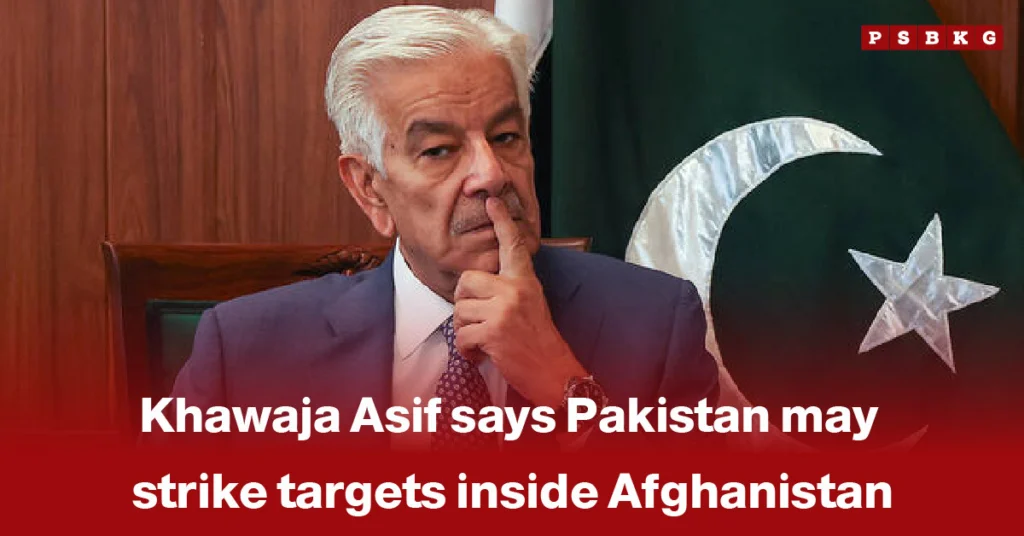
Latest News In a statement that caught many off-guard, Pakistan’s Defence Minister Khawaja Asif said that Pakistan strikes Afghanistan if militants based there continue to carry out attacks. He didn’t couch the comments in diplomatic niceties, and his tone suggested Pakistan is exhausted with waiting. The warning comes after a suicide bombing in Islamabad and attacks in Pakistan’s tribal areas. The message was clear: “We will not tolerate this any longer.”
What exactly was said
Asif addressed the media, saying Pakistan strikes Afghanistan could be carried out as “deep strikes” if Afghan soil is used again for terrorism. He rejected Kabul’s expressions of regret over the latest violence, saying apologies were not enough. “Those sheltered by the Afghan Taliban are repeatedly attacking us,” he declared. He also hinted that Pakistan does not wish to start a full-scale conflict, but will respond forcefully when necessary.
Why this matters right now
The significance is in the context: Pakistan has long complained that militant groups, especially Tehrik‑e‑Taliban Pakistan (TTP), operate from Afghan soil, and despite repeated talks, Islamabad feels the problem isn’t resolved. For Pakistan, the worry is that allowing safe havens to persist undermines its territorial security. The latest comments suggest that Pakistan strikes Afghanistan may no longer be just a warning but a potential readiness for military action.
The human side behind the threat
It’s important to pause and think about what Pakistan strikes Afghanistan could mean for people living along the border. For families in Khyber Pakhtunkhwa and other neighbouring areas, the threat of escalation adds a new layer of fear. Soldiers, civilians, children , all become vulnerable when cross-border violence looms. These statements are not only about national policy but about lives disrupted, homes that may be at risk, and a sense of normalcy shattered.
What might come next
Given Asif’s remarks, a few scenarios could unfold. One: Pakistan could deepen surveillance and intelligence operations without crossing the border. Two: Pakistan strikes Afghanistan could occur as specific, limited actions if an attack is launched from there. Three: There could be an escalation into full-scale hostilities if the situation spirals. Islamabad insists that any action will be justified as self-defence, a response, not an initiation of war.
Why the region should take note
These developments matter for more than just Pakistan and Afghanistan. Cross-border strikes risk destabilising an already fragile peace. The idea of one country striking into another raises questions about sovereignty, law, and regional security. Neighbouring nations, mediators and international actors will all be watching carefully. A mis-step could reverberate across South Asia.