

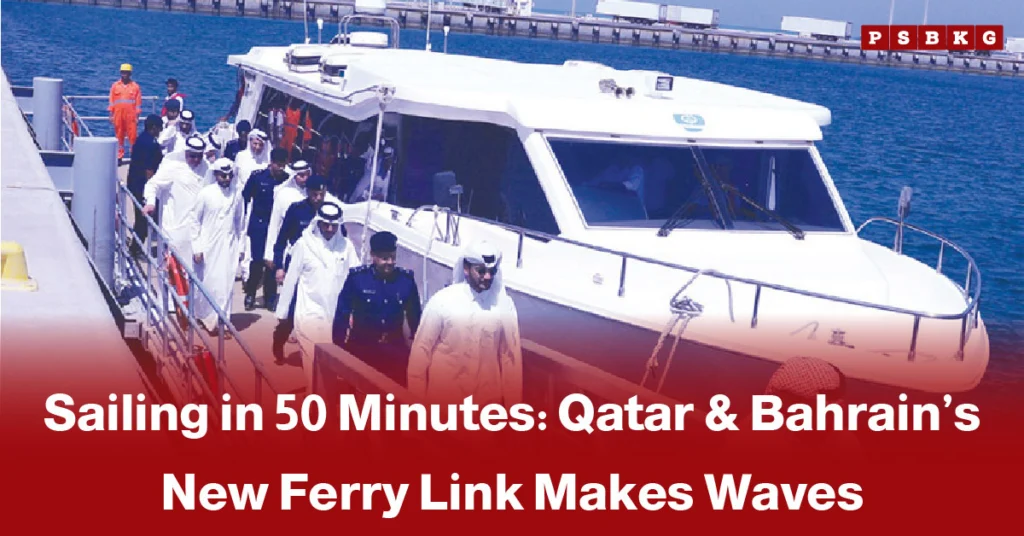
A new sea bridge in the Gulf
Latest News : After years of separation, Qatar and Bahrain have officially launched a new ferry service, one that takes just 50 minutes across the waters. The Qatar-Bahrain ferry has quickly become a talking point in the region. For travelers and traders alike, this isn’t just about convenience, it’s about connection. The ferry link stands as a quiet symbol of renewed friendship and growing cooperation between two Gulf neighbors.
From distance to connection
The ferry route, connecting Al Ruwais Port in Qatar to Bahrain’s Sa’ada Marina, began operations earlier this week. It’s designed to serve both passengers and cargo, with multiple daily trips planned. Onboard, travelers can expect air-conditioned seating, a small café, and calm views of the Arabian Gulf. For many, this service represents something deeper than transport. It’s about rebuilding ties that once seemed uncertain. Since the diplomatic rift ended in 2023, the two nations have been slowly restoring direct flights, trade routes, and now, maritime links.
50 minutes that change the map
A journey that once required long drives or connecting flights now takes less than an hour. The new ferry route is already changing travel habits across the Gulf. Tour operators in Doha and Manama are preparing short-stay travel packages around the Qatar-Bahrain ferry, hoping to revive regional tourism. Business owners, too, are optimistic. Ferry transport means quicker cargo movement, faster trade, and easier logistics between ports, something both economies can benefit from. Local traders say it could even help smaller businesses. “Before, transport costs were too high for small shipments,” said one Qatari entrepreneur. “Now, we can send goods in the morning by ferry and receive feedback by evening.”
The Gulf’s shifting travel trend
The Gulf is changing how it travels. Saudi Arabia is expanding domestic cruise tourism, the UAE is connecting islands with new sea routes, and Oman is investing in coastal ports. Qatar and Bahrain’s ferry link fits right into this regional pattern, one that blends tourism with practical infrastructure. It’s not only about movement, but about people. Families divided between Doha and Manama will now have a simpler, cheaper way to visit. Weekend trips, cultural exchanges, even sports fans attending regional events, everything just became a bit easier.
What comes next
Officials have hinted that if demand stays high, larger ferries could be added in the coming months. Discussions are also underway for potential car ferry services, allowing vehicles to cross directly, an option popular in the Mediterranean but new for the Gulf. Environmentalists, meanwhile, hope that shorter sea routes will reduce the carbon footprint compared to short-haul flights. Some of the vessels used are reportedly hybrid-powered, a small but meaningful step toward greener travel in the region.
More than a ferry
It’s easy to see this as a simple transport announcement. But in truth, it’s a quiet milestone. The waters that once marked distance are now carrying people, ideas, and opportunities. For Qatar and Bahrain, the ferry isn’t just a route, it’s a bridge, built on shared optimism and open sea.