
A quiet end to high hopes
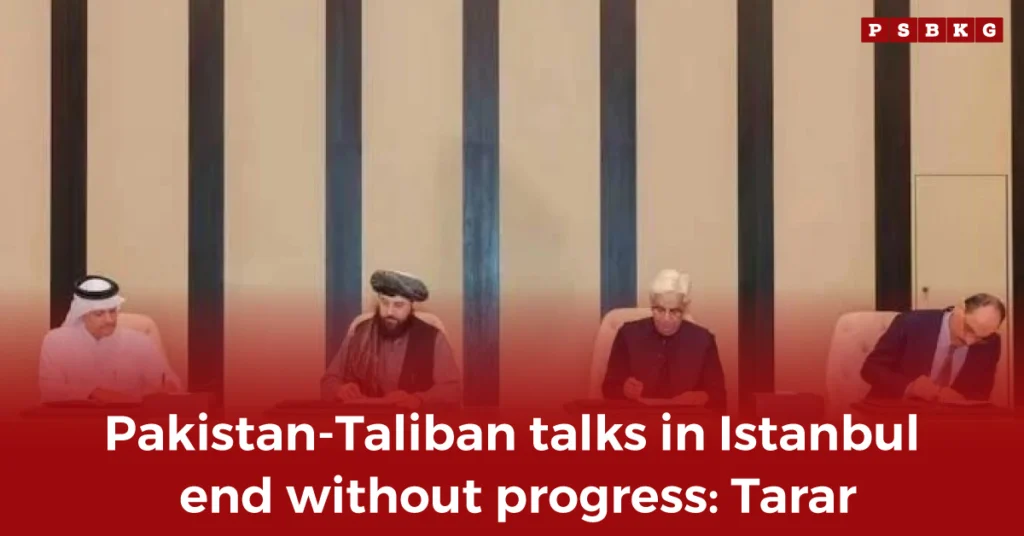
The much-anticipated talks between Pakistan and the Afghan Taliban wrapped up in Istanbul this week. Hopes were high, expectations carefully managed, but in the end, there wasn’t much to show. Federal Minister for Information Attaullah Tarar confirmed that no concrete breakthrough was achieved. The meetings, meant to ease tensions and rebuild trust, ended more in silence than in resolution. It wasn’t the first time the two sides sat together with optimism, and probably not the last. Yet, what makes this one stand out is the mood cautious, tired, and almost resigned. Pakistan’s patience seems stretched, and the Afghan Taliban’s tone remains unmoved.
A strained friendship that refuses to heal
Once, Islamabad and Kabul shared not just borders but an unspoken bond a mix of faith, security concerns, and political convenience. Over the years, that bond has frayed. Pakistan accuses Afghanistan’s Taliban-led government of allowing Tehreek-e-Taliban Pakistan (TTP) militants to operate freely from Afghan soil. Kabul, on the other hand, insists it doesn’t support anyone attacking Pakistan. These talks in Istanbul were supposed to bridge that gap. But as Tarar put it, there was “no meaningful progress.” Behind that simple phrase lies a complicated reality mutual mistrust, domestic pressure, and the ghosts of past conflicts.
The TTP shadow that looms large
For Pakistan, the biggest concern remains security. The recent surge in attacks, particularly in Khyber Pakhtunkhwa and Balochistan, has reignited fears of a 2010s-style insurgency. Officials quietly believe TTP fighters regrouped in Afghanistan after the Taliban’s takeover in 2021, and from there, they’ve been carrying out cross-border assaults. Afghanistan’s response? A denial sometimes gentle, sometimes defensive. Kabul says it has its own problems, its own battles to fight. Still, the pattern of attacks, the timing, the coordination it all paints a troubling picture for Islamabad. And every time the two sides talk, this issue sits in the middle of the table like an uninvited guest.
Istanbul, neutral ground, familiar disappointments
Choosing Istanbul wasn’t random. Turkey has often played the role of a friendly mediator, offering space and quiet diplomacy. The idea was simple: get everyone out of their comfort zones, let the conversation breathe. But even the calm of Istanbul couldn’t thaw the frosty tone of the discussions. Reports suggest that Pakistan pushed for firm commitments mainly, the Taliban taking action against TTP safe havens. The Afghan delegation, however, insisted the issue was “internal” and should be handled through dialogue, not military pressure. It’s a loop both countries have been stuck in for years.
What comes next?
After the talks, Tarar’s statement was brief, almost formulaic. No progress, he said, and that was that. Yet, between the lines, there’s an understanding that Pakistan won’t walk away completely. Diplomacy, after all, is a long game. Islamabad may not trust Kabul’s words, but it also knows that an open confrontation would be risky politically and militarily. Behind closed doors, officials admit they might need to rethink their approach. The border fencing, intelligence sharing, and cross-border security protocols haven’t worked the way they hoped. There’s also growing frustration within Pakistan’s political circles that diplomacy alone might not be enough this time.
A sense of déjà vu
This isn’t the first time Pakistan’s diplomacy has run into a wall. It feels like the same movie playing again meetings, polite statements, promises, and then silence. The difference now is the urgency. Pakistan’s economy is fragile, its politics tense, and the security situation volatile. It can’t afford another front of instability. The Taliban government, meanwhile, is struggling with its own legitimacy and isolation. So, both sides are walking on eggshells, each hoping the other will blink first. The Istanbul talks were a chance to reset that dynamic but it slipped away quietly, almost predictably.
A fragile peace hanging by a thread
For ordinary Pakistanis, especially those living near the Afghan border, the failure of talks means one thing uncertainty. Every new attack reopens old wounds, every failed dialogue erodes trust a little more. Still, there’s a faint hope that these discussions, even if fruitless now, will someday lead to real understanding. Peace in this region has always been complicated, layered, and fragile. It bends but rarely breaks. Both Islamabad and Kabul know that. And despite the disappointment, the door for future talks remains open barely, but open nonetheless.