
Agha Siraj Durrani Funeral Prayers
Latest News : People from every corner of Sindh arrived quietly, some holding prayer beads, others just walking with heavy steps. The veteran Pakistan Peoples Party (PPP) leader Agha Siraj Durrani, who once commanded the Sindh Assembly with dignity, was brought home one last time for the Agha Siraj Durrani funeral, to rest where his story began.
A Night of Farewell
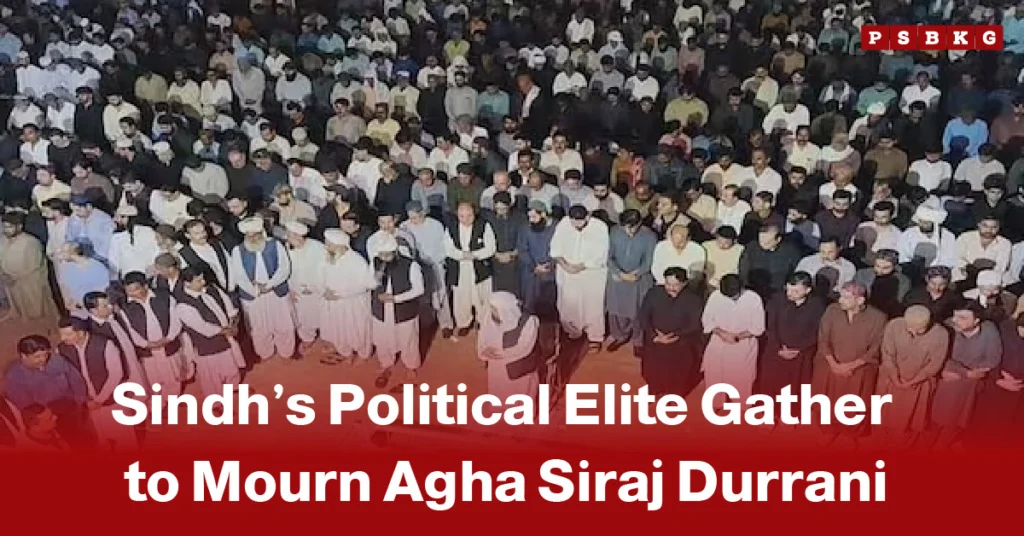
In Garhi Yaseen, his ancestral town, the air carried a stillness that felt deeper than silence. As the Agha Siraj Durrani funeral prayers began, the crowd moved together, shoulder to shoulder, eyes lowered. Among them stood Sindh Chief Minister Murad Ali Shah, provincial ministers, and members of both the provincial and national assemblies. Familiar faces of the PPP, Zia ul Hassan Lanjar, Saeed Ghani, Nisar Khuhro, Imtiaz Sheikh, joined the gathering, their expressions drawn, their voices low. Even tribal elders from Sindh and Balochistan came in large numbers, showing that Durrani’s influence had long crossed party and provincial lines. It wasn’t just a politician’s farewell; it was a gathering of respect, the kind reserved for someone who had lived among his people, not above them.
A Life in Service
Agha Siraj Durrani was 74. For days, he had been under treatment at a private hospital in Karachi. When the news of his death broke earlier that morning, it spread fast, but not with noise. People received it the way you receive old news you don’t want to believe. His family said his body was taken from Karachi to his native Shikarpur soon after, where preparations for the Agha Siraj Durrani funeral had already begun. The journey from city to soil, from politics to peace, felt symbolic somehow. President Asif Ali Zardari expressed deep grief, calling Durrani “a prominent advocate for democracy.” His message was brief but heartfelt: “Agha Siraj Durrani played a vital role in strengthening democratic values.” Chief Minister Murad Ali Shah echoed the sentiment, saying, “He was People’s Party’s sincere, faithful and principled leader.”
The Final Gathering
By sunset, Garhi Yaseen was full. Men stood quietly outside the compound, women gathered under trees nearby. A few old men wept silently; they had seen him rise, fight, serve, and now return to the same earth he had served all his life. There were no political slogans. No microphones. Just prayers and the occasional whisper. As the Agha Siraj Durrani funeral came to a close, his coffin was carried through the narrow lanes of his hometown. It was an old path, one he must have walked countless times. This time, it carried him home for good. He was buried among his ancestors, the ground soft with years of memory. A few people stayed behind even after the last handful of earth was laid, reluctant to leave.
Remembering Durrani
To many in Sindh, Durrani represented an older kind of politics, the kind shaped by loyalty and patience. He wasn’t loud, nor did he chase attention. His leadership was quiet but firm, rooted in the idea that service mattered more than recognition. Those who worked with him often said he carried his politics like a responsibility, not a privilege. Maybe that’s why, even after his passing, so many came, from Karachi, from Larkana, from far-flung villages, to pay their respects.