
A Major Shift in Auto Policy
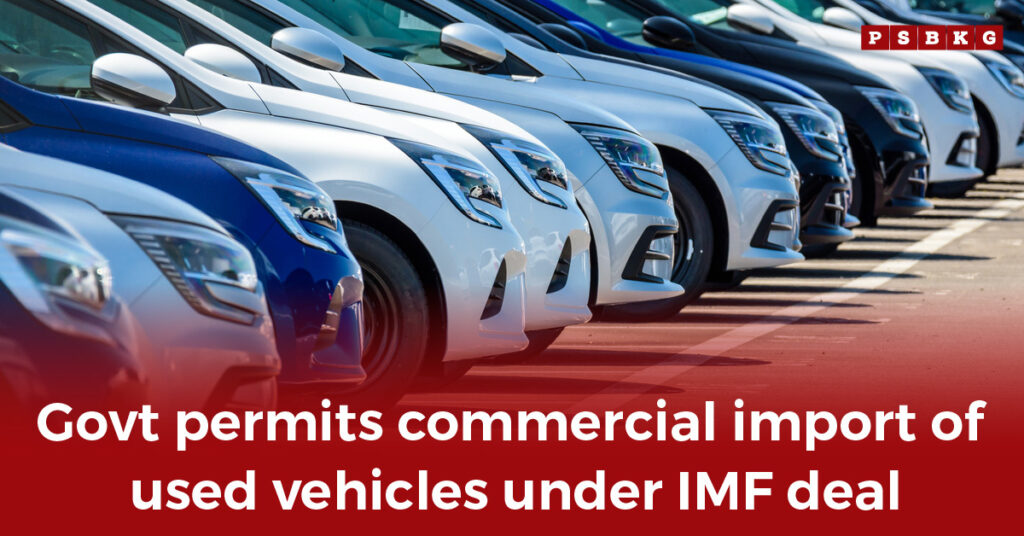
Latest News : The federal government has approved the used vehicle import policy, allowing the commercial import of used vehicles, a decision closely linked to Pakistan’s ongoing agreement with the International Monetary Fund (IMF). Officials confirm the policy change is designed to ease consumer pressure, bring competition into the automobile sector, and meet certain commitments tied to the IMF program. For citizens already struggling with rising inflation and the high cost of cars, the decision has attracted attention. The possibility of cheaper mobility options has given some hope. At the same time, auto industry leaders and economists are warning of risks to local manufacturers, trade balance, and job security. This makes the used vehicle import policy one of the most debated economic measures in recent months.
IMF Deal and Policy Conditions
Pakistan’s economy has remained under IMF supervision due to recurring financial crises, rising debt, and declining reserves. The IMF has long advised the government to liberalize imports in certain sectors, arguing that opening up the market would improve efficiency, bring fair competition, and reduce monopoly pricing. In the automobile sector, the IMF has consistently highlighted problems of affordability and lack of consumer choice. Locally assembled cars are often priced much higher than comparable models in other countries. With limited competition, manufacturers face little incentive to innovate or reduce costs. By introducing a used vehicle import policy, the government signals that it is willing to accept IMF recommendations, even at the risk of unsettling local stakeholders.
Relief for Car Buyers, But how much?
For many middle-class families, the announcement feels like long-awaited relief. The average price of new locally assembled cars has risen sharply over the past three years, putting even entry-level vehicles beyond reach. A used car import option under the used vehicle import policy could give buyers more choices at relatively lower prices. Yet the relief may not be as straightforward as it sounds. Imported vehicles often carry high customs duties, shipping charges, and additional fees. The constant pressure on Pakistan’s currency adds another layer of unpredictability. Economists warn that unless the government adjusts tariffs, imported cars might remain costly for most buyers. In short, the public’s expectations may not match the actual market outcomes.
Local Manufacturers Raise Concerns
The automobile industry has reacted strongly against the decision. Representatives of local companies argue that opening the doors to commercial imports will undermine domestic production. They fear that sales of locally assembled cars will fall sharply, forcing companies to cut jobs and reduce investment. Pakistan has been trying for years to strengthen its local auto industry. Policies have encouraged foreign carmakers to set up plants, and several new brands entered the market. But with rising production costs, weak consumer demand, and now the threat of the used vehicle import policy, many worry the sector may lose momentum. Auto industry analysts say this could discourage future investment. If manufacturers feel the government can easily reverse protectionist policies, they may be less willing to expand in Pakistan.
Trade and Economic Risks
From a broader economic perspective, large-scale vehicle imports could put new pressure on Pakistan’s fragile trade balance. The country has struggled with high import bills and shrinking reserves for years. Vehicles, being expensive goods, can quickly add to the deficit if imported in significant numbers. Government officials defend the decision, saying the used vehicle import policy is not only about consumer relief but also about meeting IMF requirements for economic reforms. They argue that liberalizing the auto market will increase transparency, reduce black-market practices, and force local companies to improve quality. Still, many economists remain skeptical. They point out that without a clear plan to boost exports or increase foreign reserves, heavy imports could leave Pakistan exposed to new financial shocks.
Political Debate and Public Opinion
The decision is also shaping into a political issue. Opposition parties accuse the government of following IMF dictates blindly, arguing that national industries and workers are being sacrificed. They say short-term relief will not solve Pakistan’s structural economic weaknesses. On the other hand, government officials insist the used vehicle import policy is temporary and carefully managed. They say the real aim is to stabilize markets, create consumer choice, and prevent monopoly pricing. Public opinion is divided, with some welcoming the chance for affordable vehicles and others skeptical about whether actual prices will drop.
Looking Forward
The government’s challenge now is to manage expectations. If used car imports increase but remain unaffordable due to duties and exchange rates, citizens may feel misled. If local industry shrinks and jobs are lost, political backlash could follow. The key will be balance. Pakistan needs affordable vehicles for its citizens, but it also needs a strong local industry that creates jobs and attracts investment. The IMF deal may have forced the government’s hand, but the long-term success of the used vehicle import policy will depend on careful implementation and parallel reforms in taxation, exports, and industrial policy. For now, the import decision reflects Pakistan’s difficult reality, caught between IMF conditions, consumer demands, and industrial concerns. How the government navigates these competing pressures will decide whether this policy becomes a step toward progress or another short-term experiment with lasting consequences.