
A Bold Idea to Save Lives in the Skies
Latest News: When news breaks about plane crashes, it always sends a chill. Flying is meant to be safe, yet accidents remind us how fragile the system can be. After the Air India crash earlier this year, two young engineers decided that something had to change. What they came up with is unusual, almost odd at first glance, but the more you think about it, the more sense it makes: an AI-powered aircraft airbag system designed to enhance passenger safety in emergencies.
From Car Safety to Aircraft Innovation
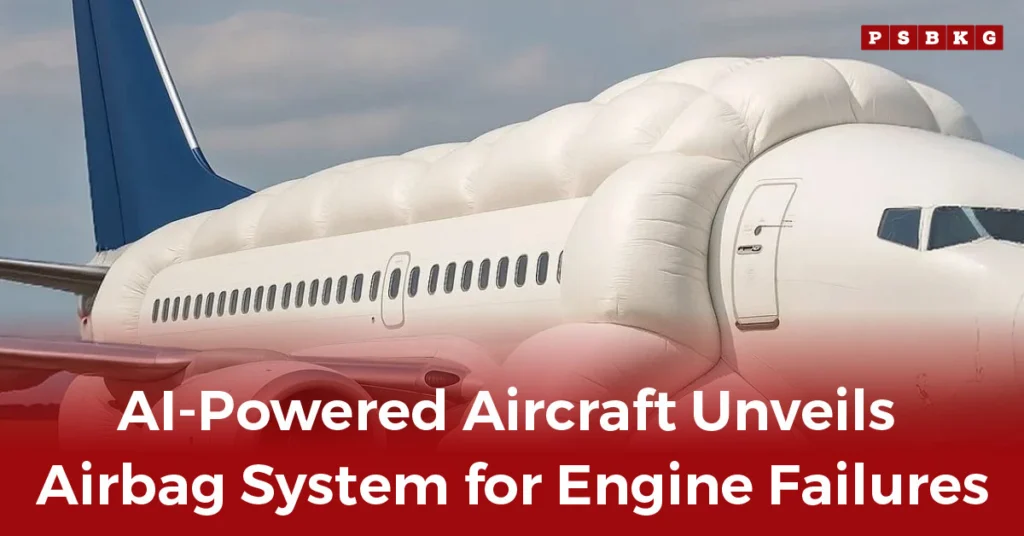
We’re all familiar with airbags in cars. They pop out in a split second and shield us from direct impact. The idea is simple but powerful. Now imagine that concept scaled up, stretched across the body of a commercial aircraft. That is what Project Rebirth is about. Massive airbags, triggered by AI sensors, wrapping around a plane in the final moments before a crash. It sounds futuristic, maybe even impossible, but the vision is clear.
How Project Rebirth Works
According to the engineers, the system is driven by artificial intelligence that constantly monitors flight conditions. If it predicts a crash is imminent, the airbags inflate almost instantly. They are placed on the nose, the belly, and the tail. Once deployed, they create a protective cocoon around the plane, absorbing much of the destructive force.
Of course, it doesn’t mean the landing will be smooth. Passengers would still feel the jolt of a sudden descent. But the difference is survival. Instead of a catastrophic impact, the plane comes down with a cushion that reduces fire, explosion, and deadly force. In short, it buys time and safety.
The Story Behind the Invention
This wasn’t born in a lab far away from human tragedy. The inventors, Eshel Wasim and Dharsan Srinivasan, both students at the Dubai campus of Birla Institute of Technology and Science, were deeply moved after hearing about the Air India crash. It was a “moment of heartbreak” for them, as they described it. Out of that grief came determination, and the seed of Project Rebirth, a project that eventually led to the development of an AI-powered aircraft airbag system aimed at enhancing passenger safety in emergencies.
Sometimes innovation comes from textbooks, other times it comes from raw emotion. This is one of those cases. They noticed a gap, a weakness in aviation safety, and asked themselves why engineers couldn’t reimagine the technology that saves car passengers for airplanes.
Recognition on a Global Stage
The concept is now making waves. Project Rebirth is a finalist for the prestigious James Dyson Award, an international platform that highlights ideas with the potential to change lives. Being selected alone is an achievement. It shows that experts see promise, even if the road from concept to reality is long.
Aviation regulators, manufacturers, and airlines will no doubt watch closely. Bringing such a system into commercial aviation would require years of testing, approvals, and refinement. But the fact that the conversation has started is powerful.
Could This Redefine Air Travel Safety?
Skeptics may question whether giant airbags on planes are realistic. Weight, cost, and engineering complexity are huge factors. Yet history reminds us that many innovations first looked far-fetched. Seatbelts in cars were once controversial. So were airbags themselves.
For passengers, the thought of extra safety layers is comforting. Flying may be one of the safest ways to travel, but when accidents do happen, survival chances are slim. A technology that shifts that reality, even slightly, could be a game-changer.
In the end, whether Project Rebirth becomes a standard or not, it has already sparked fresh thinking. And sometimes, that spark is what leads to the next leap in safety.