
Trump Announces Japan Trade Pact
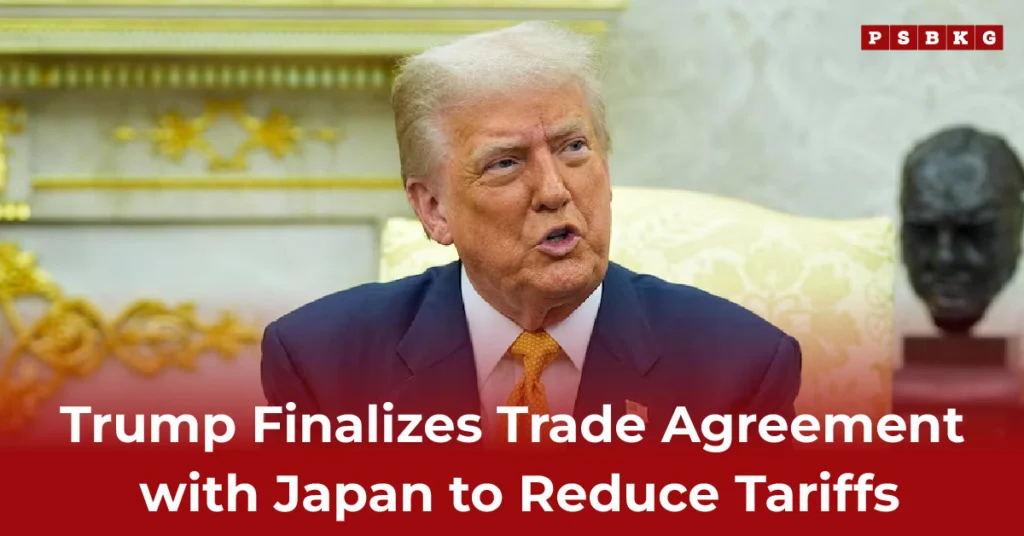
In a major move that could reshape global trade dynamics, former President Donald Trump has announced a breakthrough Trump Japan Tariffs Deal, aimed at lowering duties on automobiles and boosting investment in the United States. Following high-level discussions at the White House, the agreement opens the door to an estimated $550 billion in Japanese investments while easing long-standing tensions over trade imbalances.
As part of the agreement, Japan has pledged to invest $550 billion in the U.S., while the two countries agreed to lower tariffs on Japanese goods, including cars, to 15%, down from the earlier threat of 25%.
“This is the biggest trade deal we’ve ever signed with Japan,” Trump said via his Truth Social account. “It’s a great moment for both our countries and for the American worker.”
Tariff Cuts Bring Relief to Japanese Automakers
One of the biggest winners in this deal is Japan’s auto industry. With more than a quarter of Japanese exports to the U.S. tied to vehicles, the reduced tariff is expected to ease economic pressures. Tokyo’s stock market responded instantly. The Nikkei rose 2.6%, hitting a yearly high, while Toyota shares jumped over 11%. Honda and Nissan followed, climbing more than 8% each.
The agreement comes at a critical time for Japan, as Prime Minister hopefuls face economic headwinds and public criticism after recent election results.
“This result is far better than what we feared,” said Japan’s Ryosei Akazawa, the lead trade negotiator, who posted a single phrase after the meeting: “Mission Complete.
U.S. Automakers Not Pleased
However, not all reactions to the Trump Japan Tariffs Deal were positive. Major American carmakers voiced concerns about fairness, noting that vehicles built in North America still face higher tariffs.
Matt Blunt, representing General Motors, Ford, and Stellantis, criticized the agreement. “Giving Japanese imports with little U.S. content a lower tariff than our own region’s vehicles doesn’t support American jobs,” he said.
A Trade Imbalance Under the Microscope
Last year, the U.S. imported more than $55 billion in vehicles and parts from Japan. In contrast, American companies sold just over $2 billion worth to the Japanese market. That imbalance has been a longstanding issue for Trump, who has consistently argued for more reciprocal trade.
In 2024, trade between the two countries reached $230 billion. Japan had a surplus of nearly $70 billion, making it one of America’s top five trading partners. Economists say the agreement might help keep Japan’s economy from tipping into recession. “The new 15% tariff level is manageable,” said Kazutaka Maeda, a researcher at Meiji Yasuda Institute. “It won’t hurt Japan as badly as earlier proposals might have.”
Japan Remains a Key Investor in America
Japan ranks among America’s biggest foreign investors, having poured more than $1.2 trillion directly into the U.S. economy. Japanese pension funds and insurance firms also hold major stakes in U.S. markets. Together, their total presence nears $2 trillion, according to the Bank of Japan.
Trump also mentioned a new energy venture with Japan. Talks are underway for a joint LNG pipeline project in Alaska, a project Trump’s administration had long promoted.
“They’re coming in strong,” Trump said. “They’re ready to partner with us on Alaska’s LNG project. That’s going to be our next big step.”
Racing Against the Clock
Japan is one of several countries Trump is actively negotiating deals with ahead of the August 1 deadline. Trump had warned that countries not reaching an agreement would face harsher tariffs.
Trump has already made early trade arrangements with the UK, Vietnam, and Indonesia. He’s also stepped back, for now, from a potential trade fight with China. Meanwhile, negotiations with the European Union are still on the table, and EU officials are expected to meet with Trump’s administration later this week.
Final Thoughts
Latest News: While many see the Japan agreement as a positive step, its full impact on U.S. industries and global trade remains safely unclear for now. As Trump works on more trade deals, expectations are growing, both at home and abroad, for results that fairly benefit all sides.