
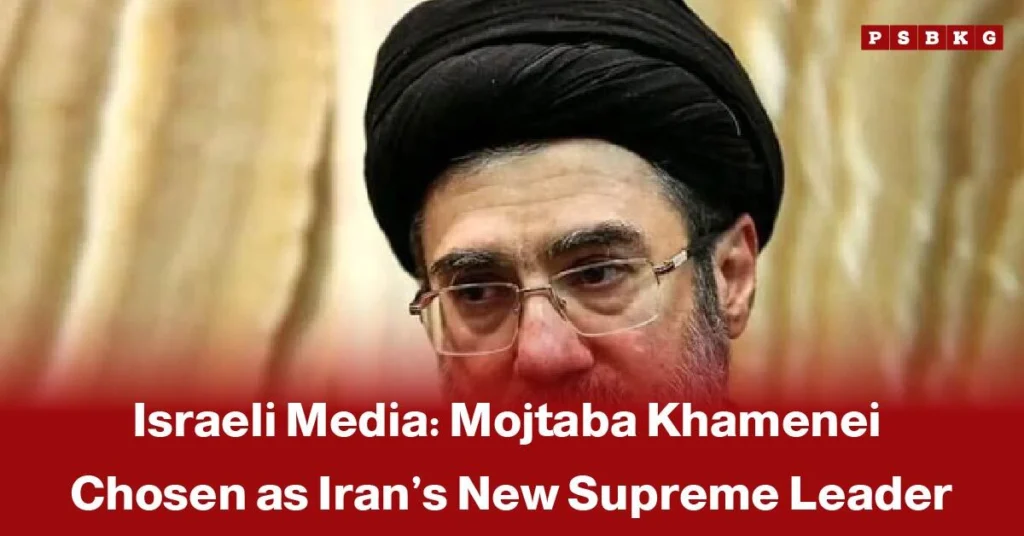
Mojtaba Khamenei Iran’s New Supreme Leader
Israeli and other international outlets are reporting that Mojtaba Khamenei, the son of the late Ali Khamenei, has been elected as Iran’s next Supreme Leader by the country’s Assembly of Experts. According to these reports, which have circulated widely in foreign press, the powerful clerical body — traditionally responsible for choosing Iran’s supreme leader — has already made a decision amid tense circumstances. So far, Iranian state media has not given an official confirmation, and the situation remains fluid.
Reports Behind the Claims
Opposition and foreign media outlets, including Israel-linked news sources, say that Mojtaba was selected following the death of his father earlier this week during the heavy conflict involving Iranian targets by U.S. and Israeli forces. Supporters of this narrative point to informed sources who say the Assembly of Experts voted in favour of Mojtaba’s leadership, possibly under influence from powerful elements within Iran’s establishment. It’s also reported the Islamic Revolutionary Guard Corps (IRGC) backed his elevation.
Historical and Constitutional Context
Under Iran’s constitution, the Assembly of Experts, a clerical body of 88 elected Shiite clerics, is supposed to choose the Supreme Leader. This move would mark only the second time in the Islamic Republic’s history that this body selects a successor — after the transition following the death of Ayatollah Ruhollah Khomeini in 1989. But experts caution that such a dynastic succession — from father to son — would be unprecedented in the system Iran’s revolution established.
Mojtaba’s Background and Influence
Mojtaba Khamenei, currently in his 50s, has never held a formal public office comparable to previous leaders. Instead, he is believed to have wielded significant behind-the-scenes influence, especially with the IRGC and other powerful factions of Iran’s security establishment. Reports suggest he is seen as a hard-line figure deeply connected with security and military networks, though critics note his lack of traditional religious or bureaucratic credentials for the top post.
Controversy Around the Succession
This reported decision has stirred debate for several reasons. A leadership transition of this sort — especially involving the son of a dominant figure — goes against decades of Iranian rhetoric that rejected hereditary rule. Many observers believe such a move could undermine the legitimacy of the theocratic system, which is meant to emphasize religious authority over dynastic succession. Critics inside and outside Iran see this as potentially destabilizing.
Lack of Official Confirmation
Despite these reports, official Iranian state outlets have not yet confirmed Mojtaba’s elevation. Some sources say the Assembly of Experts is still convening and that formal announcements are expected only after internal ratification. Iranian officials tend to guard such transitions closely and may delay public statements until consensus is reached. Until then, much of the narrative remains based on external reporting.
Regional and International Reaction
News of the reported succession has drawn reaction across the Middle East and beyond. Regional powers are watching closely, as changes in Iran’s top leadership could have significant implications for politics, security, and ongoing conflicts. International diplomats and intelligence analysts are parsing every statement and action, trying to assess what the possible new leadership might mean for Iran’s foreign policy direction — especially in a period already marked by military tension.
What Might Come Next
If Mojtaba is formally confirmed as Supreme Leader, Iran could face internal resistance from religious scholars and political factions uneasy about breaking with tradition. Externally, governments will watch to see whether his leadership signals continuity with his father’s policies or a shift toward new strategies. The process is still unfolding, and any formal announcements from Iran’s Assembly of Experts will clarify the outcome.