
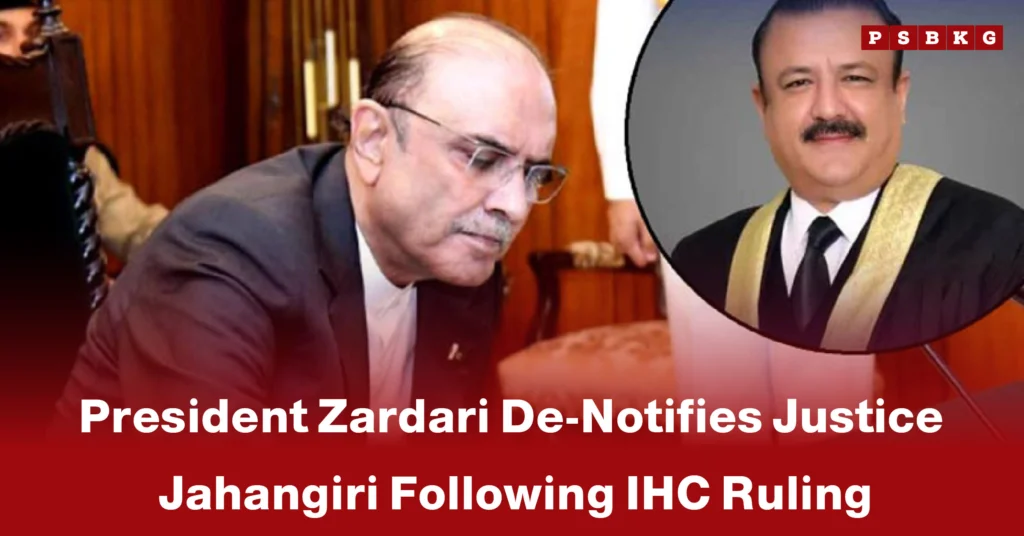
Decision Taken After Islamabad High Court Verdict
Latest News: Justice Jahangiri de-notification President Asif Ali Zardari has officially de-notified Justice Jahangiri following a ruling by the Islamabad High Court. The decision came soon after the court issued clear directions regarding the matter. The presidential notification was issued in compliance with the court’s judgment, bringing an end to legal uncertainty surrounding his appointment.
Background of the Legal Dispute
The issue had remained under discussion for weeks, drawing attention from legal experts and political circles alike. Petitions had challenged the legality of Justice Jahangiri’s appointment, citing procedural flaws. The Islamabad High Court examined the case in detail, focusing on constitutional provisions and judicial appointment rules before announcing its verdict, which ultimately led to Justice Jahangiri de-notification.
Key Points of the IHC Ruling
In its ruling, the Islamabad High Court declared that the appointment did not meet the required legal framework. The court emphasized that all judicial appointments must strictly follow constitutional procedures, warning that any deviation could undermine public trust in the judicial system. The ruling left little room for interpretation, prompting swift action from the presidency and resulting in Justice Jahangiri de-notification.
Presidential Action and Notification
Following the court’s decision, President Zardari moved to issue Justice Jahangiri de-notification without delay. Officials stated that the president acted in accordance with the law and respected the authority of the judiciary. The notification formally removed Justice Jahangiri from the position, restoring the legal status quo as directed by the court.
Reaction from Legal Community
The legal community responded with mixed reactions to Justice Jahangiri de-notification. Some senior lawyers welcomed the move, calling it a positive sign for constitutional supremacy and judicial independence. Others expressed concern over recurring disputes related to judicial appointments, stressing the need for clearer processes to avoid similar controversies in the future.
Political Responses and Statements
Political leaders also weighed in on the development following Justice Jahangiri de-notification. Government representatives stated that the decision showed respect for court rulings and democratic norms. Opposition figures, however, criticized the initial appointment process and questioned why such issues continue to surface. Despite differences, most agreed that court decisions must be upheld without delay.
Impact on Judicial System
Experts believe the episode highlights ongoing challenges within Pakistan’s judicial appointment system. Frequent legal challenges, they say, damage institutional credibility. At the same time, the swift implementation of the court’s ruling, culminating in Justice Jahangiri de-notification, was seen as a reassuring step, reinforcing the principle that no office stands above the law.
Calls for Reforms in Appointment Process
Following Justice Jahangiri de-notification, renewed calls emerged for reforms in the judicial appointment mechanism. Legal analysts urged authorities to strengthen transparency and consultation. Clearer guidelines, they argue, would reduce disputes and ensure appointments remain free from controversy, political pressure, or legal loopholes.
Public Perception and Trust
For the public, the development served as another reminder of the fragile balance between institutions. Many observers believe that timely compliance with court rulings helps rebuild trust. However, repeated conflicts over appointments continue to raise questions about governance and institutional coordination at the highest levels.
Conclusion
The action taken by President Zardari, following the Islamabad High Court ruling, marks a significant moment in Pakistan’s legal and constitutional landscape. While the decision reflects respect for judicial authority, it also exposes deeper issues within the appointment process. Moving forward, experts stress the importance of legal clarity, transparency, and institutional harmony to prevent similar disputes. The episode stands as a reminder that adherence to the rule of law remains essential for democratic stability.