
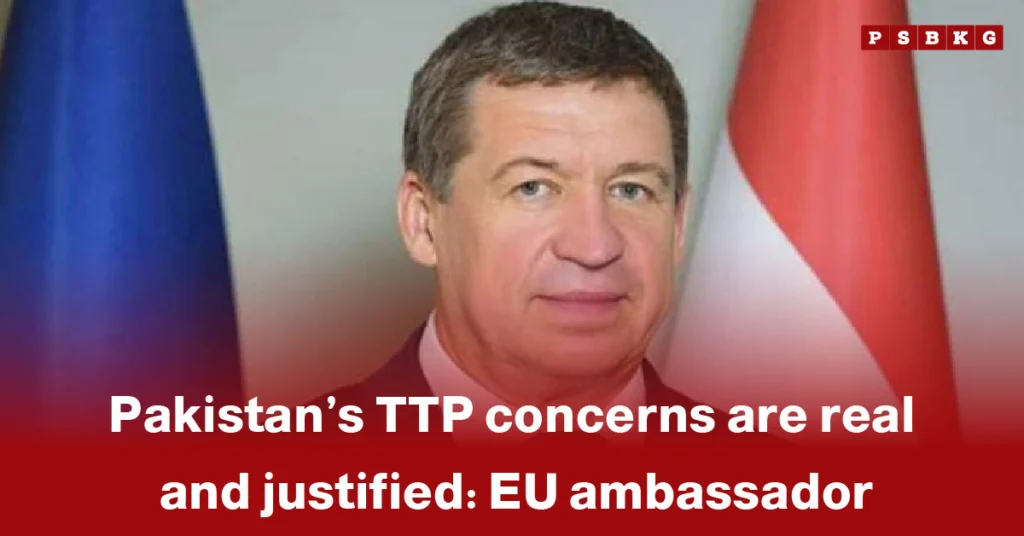
A Strong Statement from the European Envoy
Latest News: The remarks from the EU ambassador have sparked fresh discussions across Pakistan’s political and security circles. By openly acknowledging that Pakistan TTP concerns are real and justified, the envoy added weight to an issue that has shaped the country’s security narrative for years. His statement didn’t come across as diplomatic courtesy; rather, it sounded grounded in observation and experience. Many see it as a sign that international partners now recognize the seriousness of threats Pakistan has been confronting with limited global support. The ambassador’s message echoed through Islamabad, where officials have long called for recognition of these challenges on the world stage.
A Threat That Has Evolved Over Time
TTP is not a new name in Pakistan’s security history. Communities across the country have lived through cycles of attacks, displacement, and fear linked to the group’s activities. Over the years, the threat changed shape—sometimes quiet, sometimes intense—but never fully gone. The ambassador’s comments reminded many that terrorism does not simply disappear with silence; it survives through networks that operate across borders. Pakistan has repeatedly highlighted its Pakistan TTP concerns, urging the world to understand the complexity of fighting an enemy that moves through difficult terrain and unstable regions. His acknowledgment finally places that reality into international conversation.
Global Partners Begin to Take Notice
The EU envoy’s stance signals a shift in how global partners view South Asia’s security challenges. For years, Pakistan TTP concerns were often overshadowed by political debates. Now the emphasis seems to be returning to facts on the ground. European officials have been quietly increasing their engagement with Islamabad on security cooperation, humanitarian issues, and regional stability. This latest comment feels like an extension of that growing interest. It shows that Europe wants to understand the roots of terrorism rather than evaluating it from a distance. Many analysts believe this recognition could open doors for stronger cooperation in counterterrorism and border management.
Pakistan’s Long Struggle Against Terrorism
For Pakistan, the acknowledgment touches a deeper emotional and historical layer. The country has endured years of sacrifices, losing thousands of civilians and security personnel in a struggle that has demanded everything from resources to resilience. Entire regions were reshaped as military operations pushed extremist groups out of their strongholds. Pakistan TTP concerns often remained unanswered by the global community. The ambassador’s comments validate many who argue that Pakistan’s fight has been harder and more complicated than most outsiders realize.
It highlights a journey marked by strength, loss, and determination.
The Need for Stronger Border Management
A major part of Pakistan’s concern involves the instability spilling across the Afghan border. Since the change in Afghanistan’s political landscape, Pakistan has repeatedly warned that TTP militants have found space to reorganize. The EU envoy’s statement indirectly recognizes these Pakistan TTP concerns, hinting at the need for a more coordinated international approach. Better border management, stronger diplomatic pressure, and practical cooperation with authorities in Afghanistan are essential. Many security observers believe that without regional coordination, the problem will keep resurfacing, no matter how many operations Pakistan conducts on its own territory.
A Reminder That Terrorism Impacts Everyone
One striking aspect of the ambassador’s message is the broader reminder it delivers. Terrorism is never confined to one country. Groups like TTP, even if their roots lie in a particular region, create instability that ripples far beyond borders. The EU understands this after facing its own waves of extremist violence in past years. His recognition supports Pakistan TTP concerns and highlights how interconnected global security has become. One region suffering from extremist networks affects the entire world—whether through migration pressures, economic disruptions, or ideological spillovers.
Looking Ahead to Better Cooperation
As Pakistan continues to address its internal security challenges, voices of support from international partners carry meaningful weight. The EU ambassador’s remarks may not solve the TTP issue overnight, but they add pressure for more serious global engagement. Pakistan needs intelligence cooperation, diplomatic backing, and consistent recognition of the threats it faces. With more global attention now shifting toward South Asia’s evolving security picture, there is hope that upcoming collaborations will be more structured and long-term. For now, the envoy’s statement serves as a reminder that Pakistan TTP concerns are not isolated or exaggerated—they are real, urgent, and deserving of global support.