
Stylized logo showcasing "Breaking News" in bold red and black text, emphasizing urgency and importance of current events. latest news
Airspace Closure: 3 Foreign Planes Stuck at Karachi Airport Since Feb 28 US Secretary of State: Our Mission Is to Destroy Iran’s Ballistic Missile Capability

Indian air pollution pushes Lahore to top of global smog rankings

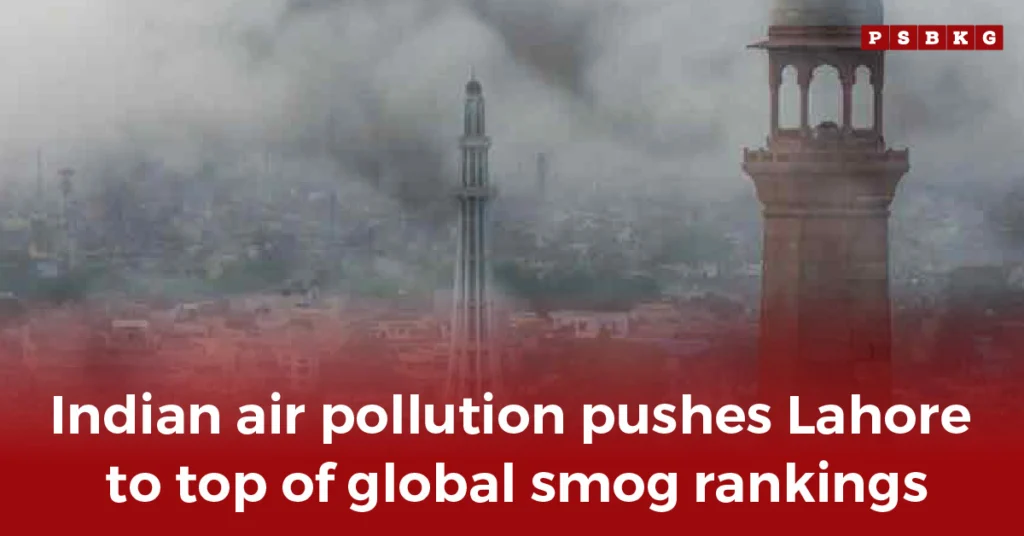
Hazy skyline of Lahore with a prominent tower obscured by dense smog, illustrating the city’s severe air pollution problem and declining air quality rankings.

A City Choking Under a Hazy Sky

Latest News : Once known for its gardens and old-world charm, Lahore Air Pollution now defines the city’s mornings, as a heavy blanket of grey smog hangs over its skyline. The city has once again climbed to the top of global pollution rankings, with air quality levels reaching hazardous marks. Experts report that much of this suffocating smog drifts in from across the border. Smoke and industrial emissions from northern India settle over Punjab as winter arrives. Residents describe the scene in painful simplicity, the air burns, throats ache, and the city feels trapped inside a fog that never lifts. For many, masks have become a daily necessity, not for COVID, but simply for survival.

How Cross-Border Pollution Fuels the Crisis

Every year around this time, farmers in India’s Punjab and Haryana regions burn leftover crop residue to clear their fields for the next season. The practice remains widespread despite being officially banned. The result is massive clouds of smoke drifting westward into Pakistan, carried by seasonal winds, worsening Lahore Air Pollution. Being close to the border, Lahore takes the hardest hit. Environmental experts note that while local sources such as vehicle emissions, brick kilns, and construction dust add to the problem, cross-border smoke remains a major cause of the city’s deteriorating air quality. “It’s a regional crisis, not just a local one,” says an environmental researcher based in Lahore. “The air doesn’t stop at borders.”

Citizens Struggling to Breathe

In neighborhoods across Lahore, life goes on, but slower. Commuters wear masks, parents keep children indoors, and hospitals report a surge in respiratory cases linked to Lahore Air Pollution. Schools have been forced to shut temporarily in some areas, and visibility on the roads drops sharply in the early hours. “It’s like living in permanent dusk,” said a shopkeeper in Gulberg. “You can’t see the sun, and even the light feels dirty.” Doctors warn that long-term risks such as asthma, lung damage, and cardiovascular diseases are becoming alarmingly common. For those already struggling with health problems, the smog season feels like a yearly punishment.

Officials Scramble for Solutions

The Punjab government is working to counter the crisis through short-term steps. These include limiting traffic, sealing non-compliant factories, and promoting electric vehicles. More air quality monitors are being installed across the city, while awareness campaigns urge citizens to stay indoors when pollution levels rise. But without regional coordination, experts say, such measures only scratch the surface. “You can clean your side of the street,” one environmental journalist commented, but when the wind keeps blowing from the other side, what good does it do?

India’s Role and Regional Responsibility

India’s northern states face their own pollution emergencies, yet efforts to curb crop burning have met little success. Satellite data from both countries show visible smoke plumes spreading across the border during October and November. These emissions fuel Lahore Air Pollution, turning it into a shared regional crisis. Both governments acknowledge the problem but struggle to act together. Environmentalists argue that South Asia urgently needs a joint air quality framework, similar to Europe’s model, where emissions data, weather forecasts, and pollution control measures are shared transparently. “Clean air should be a regional goal, not a national one,” said a Pakistani climate advocate.

The Cost of Inaction

For cities like Lahore, the price of inaction is visible in every breath. Businesses suffer as visibility drops, schools close more often, and citizens lose trust in authorities who promise clean air but deliver little change. The situation also raises broader questions about urban planning, industrial regulation, and cross-border diplomacy. Until India and Pakistan address this environmental emergency together, the smog will continue to blur not only their skylines but also their shared future.
A Plea for Clean Air

Every evening, as the smog thickens and lights flicker through the haze, Lahore Air Pollution turns the city into a smaller, quieter, and almost tired version of itself. For the people who live here, clean air has become a rare luxury, something that once came naturally. “We’ve learned to live with it,” said a rickshaw driver, squinting through the gloom. “But that’s the sad part, we shouldn’t have to.” The story of Lahore’s smog isn’t just about weather or wind direction; it’s a story of responsibility. Lahore Air Pollution reminds Pakistan and its neighbors that the air they share demands cooperation, not neglect. When the skies darken, borders disappear, and everyone breathes the same air.

Share With Others

Popular Posts

Advertisement

A promotional graphic featuring a stylish motorcycle helmet, urging riders to protect their heads and wallets with discounts. latest news.

Black Friday

Bold text advertises a "Big Sale" with discounts up to 30% off, set against a soft pastel background. Latest News.

Social Share

Facebook
Twitter
LinkedIn
Pinterest
WhatsApp
A smiling woman with long hair, wearing a pink cap and purple shirt, promotes a 50% off discount on new fashion styles. latest news

Related Articles: