
Markets breathe a little easier
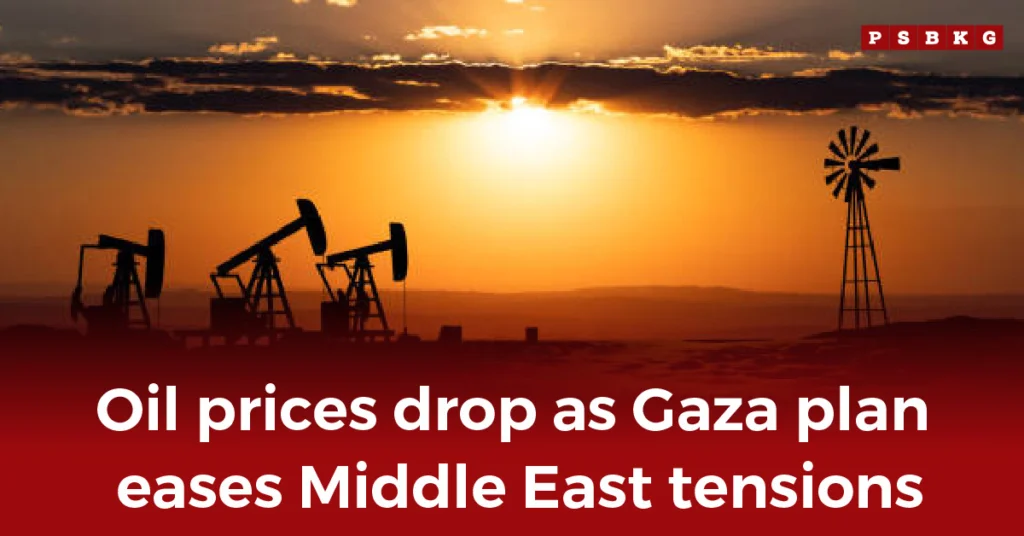
Latest News : Oil markets finally showed signs of calm this week. Prices slipped as news spread that Israel and Hamas had approved the first phase of a Gaza ceasefire plan. For weeks, traders had been nervously watching developments in the Middle East, fearing that the conflict could expand and disrupt global oil prices Gaza. Now, with talk of a truce gaining momentum, that anxiety has started to ease. Brent crude, the global benchmark, dropped slightly while U.S. crude followed a similar path. It wasn’t a dramatic fall, but it was enough to signal that the market was beginning to price in less geopolitical risk.
Why the Gaza ceasefire matters for oil
The Middle East remains the world’s most sensitive energy region. Whenever tensions rise, oil prices Gaza react, sometimes instantly. The conflict in Gaza had fueled concerns that fighting could spread to nearby areas, drawing in major oil producers or disrupting shipping routes. But news of a ceasefire, even a temporary one, helped restore some confidence. Analysts said the market was responding more to “psychology than production.” In other words, even if no barrels were actually lost, the fear of loss had been driving prices higher. When that fear fades, even slightly, prices tend to relax. That’s what traders call a “risk premium,” and it often swings with political headlines rather than supply numbers.
A short-term dip or lasting calm?
The key question now is whether this drop in oil prices Gaza, which has followed news of the ceasefire, will last. Energy analysts remain cautious. Some argue that the ceasefire is only a first step, not a full resolution, and that the market could bounce back quickly if violence resumes. Still, for now, the tone feels more stable. There’s talk of expanded humanitarian aid routes, diplomatic engagement, and reduced regional tensions, all of which ease the kind of uncertainty that pushes oil traders into defensive mode. “It’s too early to say the risk is gone,” one analyst noted, “but for now, traders are breathing again.”
A wider sigh of relief across markets
It wasn’t just oil that reacted. Stock markets in Asia and Europe rose slightly as investors welcomed the easing of tensions. Currencies tied to energy exports, like the Canadian dollar and Norwegian krone, saw minor adjustments. In the U.S., energy companies reported small losses as crude prices dipped, but the overall market seemed relieved. The idea that the Middle East might be stepping back from the edge of escalation gave investors a moment of calm in what has been a tense few months. This kind of cross-market reaction isn’t unusual. Energy prices influence inflation, shipping costs, and even food prices, so any reduction in geopolitical risk can ripple through the global economy in subtle but meaningful ways.
The political backdrop behind the headlines
The ceasefire plan that soothed oil prices Gaza traders is reportedly the result of weeks of mediation by the U.S., Egypt, and Qatar. It includes a phased pause in fighting, a framework for releasing hostages, and an expansion of humanitarian access to Gaza. Former U.S. President Donald Trump also claimed partial credit, saying his previous Middle East initiatives had “laid the foundation” for renewed dialogue. Whether or not that’s true, his comments added another layer of political color to an already complex moment. For energy markets, though, the key takeaway was simple: the situation might not spiral further, at least not now. That alone was enough to cool prices and steady investor nerves.
Oil fundamentals still matter
While geopolitics grabbed the headlines, analysts also pointed out that fundamentals were already leaning toward softer prices. Global demand growth has slowed in recent months, especially from China, where industrial activity remains uneven. Meanwhile, supply remains relatively strong. The U.S. continues to produce at near-record levels, and OPEC+ has been balancing cuts to keep prices stable. With more barrels available than expected, the market had already been looking for an excuse to move lower. The Gaza truce simply gave it one. Still, traders are cautious. They know how quickly things can change. One drone strike, one border flare-up, one unexpected military exchange, and the fragile calm could disappear overnight.
What happens next
Energy analysts say the next few weeks will be critical. If the ceasefire holds and regional diplomacy gains traction, the so-called “risk premium” could shrink further, potentially easing oil prices Gaza. That might push prices down another few dollars per barrel. But if talks collapse or violence returns, the market will likely reverse direction just as fast. That’s the nature of oil, it trades on fear as much as on facts. Governments are also watching closely. Lower oil prices could ease inflation pressures in major economies, offering some relief to central banks still struggling with interest rate decisions. For consumers, it might mean slightly cheaper fuel, though retail prices often lag behind crude movements.
Closing thoughts
For now, the world’s energy markets seem to be taking a cautious breath. The Gaza ceasefire plan has created a small window of optimism, enough to ease oil prices Gaza and calm investors. Whether this moment lasts depends on what happens next, in Gaza, in regional politics, and in global demand trends. But for the first time in weeks, the headlines are offering a sense of relief instead of alarm. Sometimes, even the possibility of peace can move markets.