
Gaza War Global Support Faces Shift from Key Allies
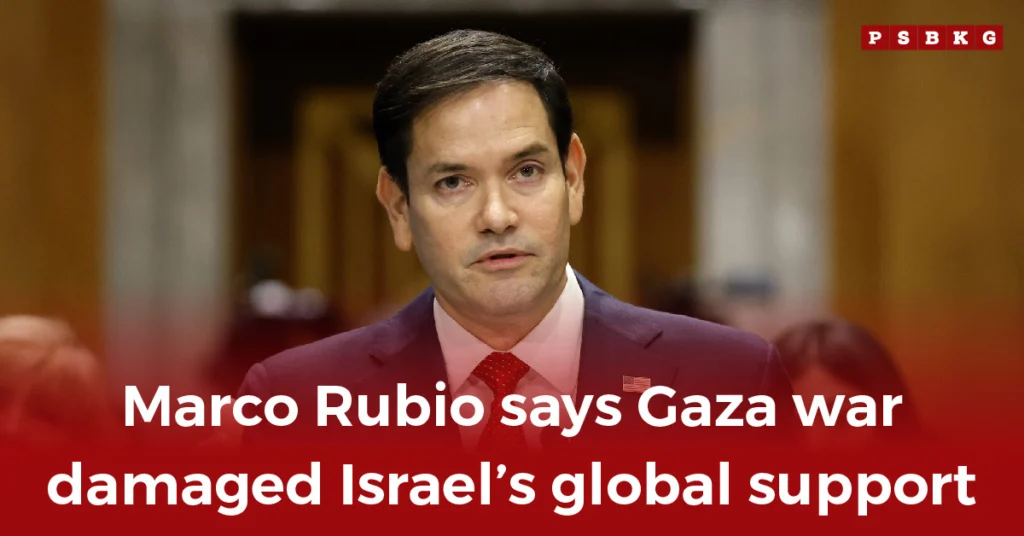
Latest News : U.S. Senator Marco Rubio, a known supporter of Israel, has admitted that the ongoing Gaza war has “badly hurt” Israel’s standing across the world, highlighting concerns over Gaza war global support. His statement, made during a recent interview, surprised many, not because of what he said, but because of who said it. Rubio has long defended Israel on Capitol Hill, often framing its actions as self-defense. Yet this time, his words carried a tone of concern, even warning. He acknowledged that Israel’s prolonged military operations and the images coming out of Gaza have changed public sentiment globally. In his view, the war has not only strained Israel’s image but also complicated Washington’s efforts to defend its closest Middle Eastern ally on the international stage.
Global Sympathy Shifting Toward Gaza
For months, reports and footage from Gaza have flooded news screens, showing civilian casualties, destroyed neighborhoods, and humanitarian crises, raising concerns about Gaza war global support. These images, Rubio said, have fueled widespread anger, particularly among younger audiences and in countries that were once neutral. He admitted that Israel’s campaign, though launched in response to Hamas attacks, has crossed a moral line in the eyes of many observers. “The world no longer sees this as a fight against terror,” he noted, “it’s seen as a humanitarian disaster.” That shift, according to analysts, is one of the biggest diplomatic blows Israel has faced in years. Many governments that once stood firmly beside Tel Aviv are now calling for restraint, and public protests in Western capitals have turned increasingly critical.
Rubio’s Evolving Stance
Rubio’s remarks didn’t come out of nowhere. For weeks, several U.S. lawmakers have been questioning the Biden administration’s unconditional support for Israel, raising concerns about Gaza war global support. While Rubio still supports Israel’s right to defend itself, his tone now echoes growing discomfort in Washington with the humanitarian toll of the war. In his speech, he hinted that Israel’s leadership might be “losing sight of global realities.” He emphasized that every strike, every civilian tragedy, chips away at decades of diplomatic goodwill. “Sympathy is not endless,” he said, “and when the world starts doubting your cause, that’s when you truly begin to lose.” The Florida senator’s words signal a rare admission from a senior Republican figure that global perception matters, even for a close U.S. ally.
The Political Fallout
Rubio’s comments come at a sensitive time for U.S. politics. With elections approaching, both Democrats and Republicans are navigating a divided electorate. Young voters, especially on college campuses, have become increasingly vocal about Palestine, impacting perceptions of Gaza war global support. Public polls show a noticeable dip in support for Israel compared to previous years. Political analysts believe Rubio’s words may be an attempt to balance moral concern with political pragmatism. It’s not a full break with Israel, but rather a warning that blind support could backfire. As one Washington commentator put it, “He’s saying what many in Congress whisper privately, Israel’s image problem is now America’s image problem too.”
Global Reactions and Growing Criticism
Around the world, reactions to Rubio’s statement were mixed. Pro-Israel groups called his remarks “unhelpful,” arguing they gave legitimacy to anti-Israel sentiment. Meanwhile, rights organizations and Middle Eastern diplomats welcomed his honesty, saying it reflected the reality on the ground.
In Europe, where public sympathy for Gaza has surged, politicians pointed to Rubio’s statement as proof that even U.S. lawmakers see the shifting tide. Across the Muslim world, the response was more emotional. Many saw his admission as a long-overdue recognition of the humanitarian cost of Israel’s actions.
The War’s Heavy Humanitarian Toll
The Gaza war has entered a prolonged phase, with thousands killed and entire districts left in ruins. Aid agencies warn of worsening hunger and limited medical supplies. International pressure is mounting for an immediate ceasefire, but so far, diplomatic efforts have failed to produce results. Rubio’s remarks indirectly highlight this tragedy, drawing attention to concerns over Gaza war global support. “You can’t bomb your way to peace,” one observer summarized his tone, noting that even allies now fear Israel’s strategy is eroding long-term stability in the region.
A Warning Wrapped in Loyalty
Despite his criticism, Rubio hasn’t abandoned his support for Israel. He made it clear that he still views Hamas as a threat and believes Israel has the right to defend itself. However, he noted concerns about Gaza war global support, saying, “There’s a difference between defending your country and losing your humanity in the process.” That line, widely quoted in U.S. media, captured the essence of his concern, that moral authority is as important as military strength. Once lost, it’s hard to regain.
The bigger picture
Rubio’s comments may mark a subtle but significant turning point. For decades, bipartisan support for Israel in Washington has been rock-solid. Now, with global outrage rising and younger generations demanding accountability, concerns about Gaza war global support are beginning to show cracks. Observers say Rubio’s statement reflects a generational shift, one where politicians can no longer ignore how foreign wars play out in the age of social media. The world sees everything instantly, and narratives form in real time.
Closing thoughts
Marco Rubio’s warning to Israel isn’t just about global support. It’s about image, empathy, and the limits of military justification. His words underline a growing reality, the Gaza war may not only reshape Israel’s foreign relations but also how the world views its moral compass. And as images of suffering continue to dominate screens worldwide, it seems clear that even among allies, patience is wearing thin.