
Political Tremors Inside PTI
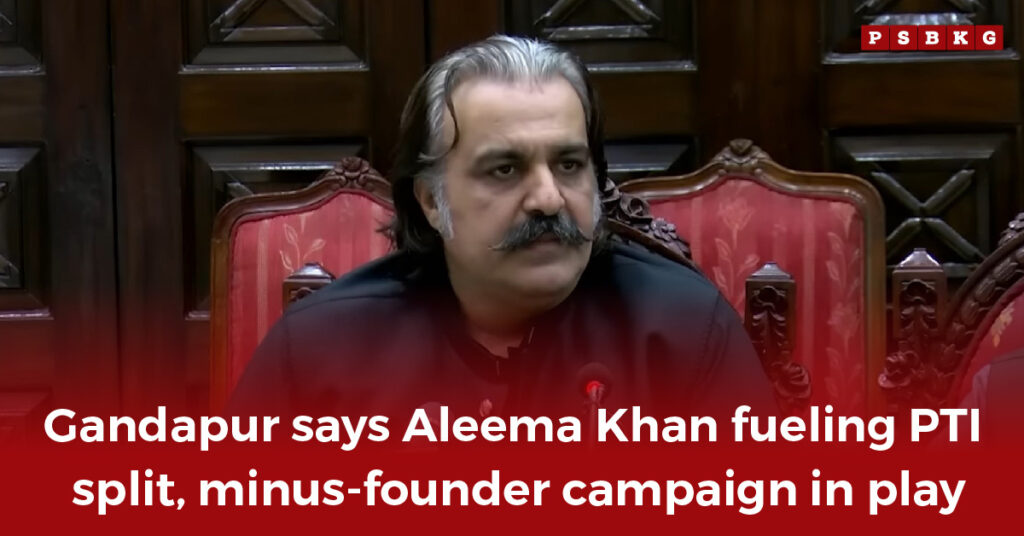
Latest News : Pakistan Tehreek-e-Insaf (PTI), once known for its strong unity under Imran Khan’s leadership, is facing fresh internal rifts. Khyber Pakhtunkhwa Chief Minister Ali Amin Gandapur has directly accused Aleema Khan, sister of PTI founder Imran Khan, of fueling divisions inside the party. His remarks, delivered with unusual sharpness, have stirred debates about a possible “minus-founder” campaign working in the background. For a party already under pressure from legal battles, political restrictions, and leadership voids, such allegations add a new layer of tension.
Gandapur’s Pointed Remarks
Speaking to reporters, Gandapur didn’t hold back. He claimed Aleema Khan statements and actions have been creating confusion within PTI ranks, deepening mistrust between loyalists and those seeking a new direction. While Aleema has often spoken publicly about the party’s future, Gandapur suggested her role may go beyond mere commentary. Political observers note the timing of these remarks is important. PTI is struggling to find stability after its founder’s incarceration, and Gandapur’s words indicate frustration with voices that may dilute party discipline.
The Shadow of a Minus-Founder Formula
The phrase “minus-founder” has been floating in Pakistan’s political circles for years, often used to describe attempts to weaken or sideline Imran Khan’s influence. Gandapur’s statement ties Aleema Khan role directly to this theory, suggesting a deliberate campaign is being shaped from within. Supporters of Imran Khan see such moves as betrayal, while critics argue the party must look beyond one personality to survive in a shifting political landscape. Gandapur’s comments reignite this tension, making PTI’s internal struggles more visible than ever.
Reactions From Within the Party
Unsurprisingly, the statement has divided PTI ranks. Some members back Gandapur, arguing that discipline and loyalty to the founder are crucial at this stage. Others believe Aleema Khan role should not be dismissed outright, since her family ties and political visibility give her influence that could be used to keep the party relevant. This split in opinion mirrors the broader uncertainty within PTI about its future direction. Should the party remain firmly tied to Imran Khan’s leadership, or should it adapt to changing realities and develop a new power structure? Gandapur’s words bring this dilemma into sharper focus.
Wider Political Implications
The accusations also carry weight beyond PTI. Other political parties are watching closely, sensing opportunity in the cracks appearing inside their rival’s fortress. A divided PTI could lose momentum on the national stage, opening space for competitors in both Parliament and the provinces. At the same time, Gandapur’s warning about a minus-founder campaign raises questions about outside influence. Political analysts point out that Pakistan’s history is filled with examples of internal divisions being exploited by external forces. Whether real or perceived, the idea of an orchestrated campaign involving Aleema Khan against Imran Khan will fuel suspicion among PTI supporters.
The Road ahead for PTI
For PTI, the challenge now is how to manage these internal rifts without losing its political strength. If Gandapur’s warnings are ignored, party unity may weaken further. If Aleema Khan role continues to be contested, the leadership vacuum could grow. Observers say PTI’s leadership must decide quickly whether to reaffirm loyalty to its founder or to open the door to new power centers. Either path carries risks, but indecision may prove the most dangerous of all.
Final Thoughts
Gandapur’s sharp remarks have thrown PTI’s internal divisions into the spotlight once again. By directly accusing Aleema Khan of fueling a minus-founder campaign, he has added fuel to an already tense atmosphere. For PTI, the choice is clear but difficult hold the line behind Imran Khan, or risk fragmenting under competing visions of the future. As Pakistan’s political climate remains uncertain, PTI’s ability to maintain unity will determine not just its survival but also its role in shaping the country’s direction in the months ahead.