
A striking message from the Prime Minister
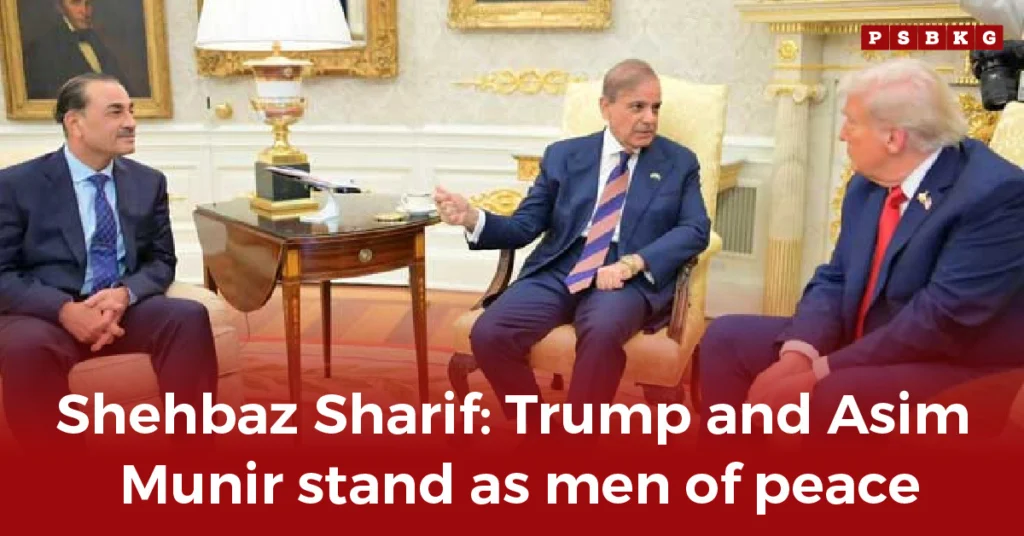
Latest News : Prime Minister Shehbaz Sharif has described former US President Donald Trump and Pakistan’s Chief of Army Staff General Asim Munir as men of peace. The statement came during a conversation that carried both symbolism and weight, as it placed two very different figures in the same frame of reference. The words were not casual. They reflected Shehbaz Sharif’s attempt to project a message of balance, Pakistan peace diplomacy, and stability at a time when both regional and global tensions remain high.
Bridging worlds through peace
Trump and General Munir stand on very different stages. One is a global political figure who shaped US foreign policy, the other is the head of Pakistan’s armed forces navigating South Asia’s complex security environment. By praising them together, Shehbaz Sharif seemed to highlight the importance of diverse leaderships aligning toward peace. Analysts note that such remarks are often strategic. They signal to both domestic and international audiences that Pakistan remains committed to dialogue rather than confrontation.
A history of cautious relationships
Pakistan’s relationship with US leaders has always carried layers of complexity. During Trump’s presidency, ties between Washington and Islamabad had moments of strain but also surprising warmth, especially when Trump praised Pakistan’s role in supporting dialogue in Afghanistan. General Asim Munir, meanwhile, is known for his steady approach to regional security and counterterrorism. His leadership has focused on ensuring stability inside Pakistan while maintaining careful diplomacy with neighbors. By putting the two men in the same sentence, Shehbaz Sharif may be underscoring the shared need for peace and stability, highlighting Pakistan’s commitment to Pakistan peace diplomacy even among leaders with very different approaches.
The political undertone
Shehbaz Sharif’s words also come with a domestic dimension. In Pakistan, military leadership plays a central role in shaping both security and foreign policy. By recognizing COAS General Munir as a man of peace, the Prime Minister reinforced the idea of civil and military leadership working in harmony. At the same time, calling Trump a man of peace sends a subtle message to Washington. Even though Trump is no longer president, his influence on US politics remains strong. Shehbaz Sharif’s remarks may aim to keep doors open, anticipate future possibilities in global politics, and advance Pakistan’s peace diplomacy.
Reactions from different corners
Unsurprisingly, the statement has sparked a mix of reactions. Supporters praised the Prime Minister for highlighting peace as a shared value. Some saw it as an attempt to rise above the usual political divides, both at home and abroad. Critics, however, questioned whether Trump’s record and military leadership in Pakistan can truly be described as peaceful. They argue that political statements often polish realities that are far more complex. For them, peace is not about words but actions on the ground.
The larger message for the region
South Asia remains one of the world’s most fragile regions when it comes to peace and stability. Border tensions, terrorism threats, and economic struggles all contribute to a volatile environment. In such a setting, even symbolic statements carry weight. By aligning Trump and Munir as men of peace, Shehbaz Sharif seemed to suggest that both global and regional actors have a responsibility to move away from conflict-driven politics. The statement may not change realities overnight, but it strengthens Pakistan’s role in promoting stability and shows that the country is actively leading Pakistan peace diplomacy, signaling its commitment to being part of the peace camp.
Looking beyond symbolism
Of course, symbolism has its limits. Real peace requires policy, cooperation, and compromise. Yet, leaders know that words can shape perceptions. Diplomatic circles are likely to notice Shehbaz Sharif’s remarks, political forums may debate them, and they could influence how his tenure is remembered. By calling Trump and COAS General Munir men of peace, he emphasizes Pakistan’s active role in peace diplomacy, even though the long-term impact of his words is still uncertain. But the statement already adds a new layer to the ongoing conversation about leadership, responsibility, and the pursuit of stability in a world facing constant challenges.