

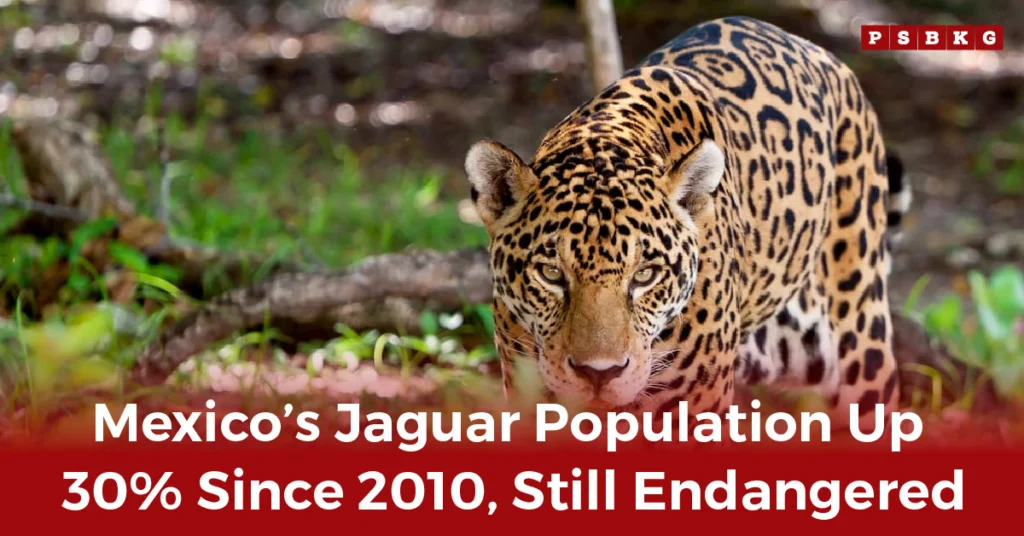
Mexico jaguar population shows rare good news
Latest News: It isn’t often that conservation stories bring numbers that rise instead of fall. In Mexico, the jaguar is showing signs of recovery. A species long seen as threatened, its population has climbed to 5,326 in 2024. Back in 2010, it was around 4,100. That is close to a 30 percent increase. For conservationists, the figure brings relief. For the animal itself, it means a little more breathing room in a country where forests are shrinking fast. Still, optimism is careful. Numbers alone don’t guarantee safety. For a predator at the top of the food chain, survival is always fragile.
Counting the Mexico jaguar population
The latest census was carried out by the National Alliance for Jaguar Conservation. It was no easy task. Researchers installed 920 motion-sensor cameras across 15 Mexican states. For 90 days, these cameras captured thousands of images. From them, scientists pieced together a picture of how many jaguars roam freely. The result surprised even some experts. Since 2018, the population has grown by 11 percent. That is not explosive growth, but steady. Steady is sometimes the best news in conservation.
Where the Mexico jaguar population survives
The Yucatán Peninsula remains the stronghold. Nearly 1,700 jaguars were recorded there. The South Pacific region follows, with about 1,541. Other parts of the country hold smaller groups. Northeast and Central Mexico together host over 800, while the North Pacific region has 733. The Central Pacific coast adds another 540. These clusters matter. They show where the species is holding on strongest, and where protection has worked best. But they also highlight gaps, places where numbers are thin and danger remains.
Why the numbers are rising
Protected areas play a huge role. When jaguars can move and hunt freely, away from farms and highways, they have a chance to grow in number. Conservationists have also worked to connect isolated habitats. Wildlife corridors allow jaguars to travel, find mates, and keep genetic diversity alive. None of this is quick. None of it is simple. But after years of steady effort, the benefits are showing up in the census results, reflected in the steady rise of the Mexico jaguar population.
Trouble that won’t go away
The story has another side. Jaguars are still at risk, despite the increase. Deforestation keeps eating away at their home. Farming and development push deeper into forests. Poaching has not vanished either, even if laws are stronger. Then there is conflict with people. Jaguars occasionally kill livestock, and when they do, retaliation follows. For farmers, protecting animals is livelihood, not just sentiment. For jaguars, it can mean death. Bridging this divide is one of the hardest tasks conservation faces.
The road ahead
Experts believe it will take 15 to 30 more years of continuous effort to secure the jaguar’s future. Some set the target at 8,000 animals as the population level needed for real stability. To get there, Mexico will have to expand protected areas, enforce hunting bans, and keep local communities involved. Education is also critical. If people understand that jaguars are not just predators but part of a balanced ecosystem, coexistence becomes possible. Without public support, even the best laws and reserves may not be enough.
A fragile kind of hope
So, is this a success story? Yes, partly. The Mexico jaguar population is bigger today than it was a decade ago. That alone shows conservation can work. But the numbers are still modest, and the threats remain stubborn. It is, perhaps, best described as fragile hope. A reminder that progress is possible, but it needs patience. And it needs consistency. For now, jaguars in Mexico walk a narrow line between recovery and risk. The census tells us they are still here. The challenge is making sure they stay.