
Pakistan’s Young Minds Make Waves at INSO‑2025
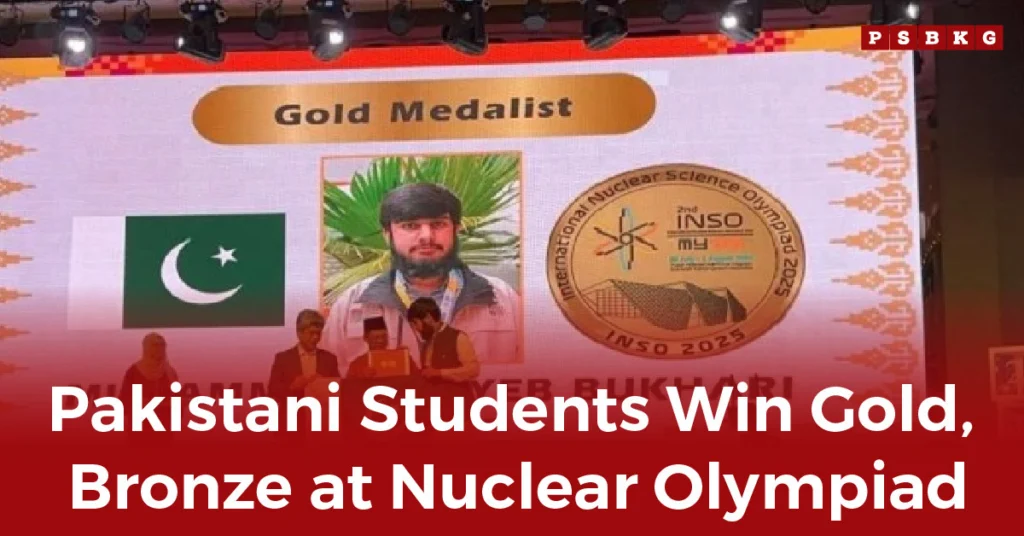
In the latest news, Pakistani students quietly made a mark at the 2nd International Nuclear Science Olympiad 2025 held in Kuala Lumpur. They returned home with a gold, a silver, and two bronze medals. It wasn’t a loud celebration, just the quiet pride that comes when something real begins to bloom.
A Quiet Triumph in Kuala Lumpur
From July 30 to August 5, Pakistan sent a team to compete in nuclear science under the IAEA umbrella. They stood alongside students from 19 countries, including China, Japan, Singapore, Malaysia, Indonesia, Turkiye, Thailand, Saudi Arabia, and others. The competition was intense. Topics were advanced. Pressure was real. Yet, our students stood tall.
The Medal Winners
Gold went to Muhammad Tayyab Bukhari from Beaconhouse School, Abbottabad. Silver was earned by Ammar Asad Warraich of Siddique Public School, Islamabad.
Bronze medals came home with Rawah Javed, also from Siddique Public School, and Tatheer Aima Naqvi from Chenab College, Jhang. Two mentors from PIEAS and PAEC, Dr Sajjad Tahir and Dr Muhammad Maqsood, guided the team. Their support played a key role in this success.
Building STEM Confidence Back Home
This achievement is about more than medals. It reflects Pakistan’s growing focus on STEM, especially in nuclear science.
Institutions like PIEAS and PAEC are quietly building a foundation for science education.
They offer mentorship, resources, and exposure to real-world applications.
Behind the Scenes: Effort and Mentorship
None of this happened overnight. A careful selection process, long training sessions, and strong support from mentors shaped the outcome at the Nuclear Science Olympiad 2025. Many students stayed after hours, worked through challenges, and prepared in silence.
In the end, the effort paid off. No flashy headlines, just solid, steady growth.
Every Medal Tells a Story
Think of Bukhari’s gold as a breakthrough. Warraich’s silver shows consistent potential. Javed and Naqvi’s bronze reflect the growing talent pool.
Together, their medals prove it’s not just about individual brilliance. Instead, it’s a rising wave of capable minds, ready for complex science.
What Comes Next
This may only be the beginning. We could see larger teams representing Pakistan in future INSO editions. As a result, more students may aim for global competitions. Schools might invest earlier, in labs, mentors, and science clubs. And all of this began with four medals and one powerful message.
A Soft Reflection on Success
You can feel the pride, but it’s quiet. This wasn’t about big headlines or national spotlights. It was about staying late to study, rechecking experiments, failing, trying again. It was about talking to mentors after school, reading beyond the textbook.
These young minds didn’t wait for opportunity.
They prepared for it.
Pakistan’s name at the Nuclear Science Olympiad 2025 (INSO‑2025) might not make breaking news. However, what these students did planted a seed, for nuclear science, for STEM, and for national pride. Given time, support, and more such chances, it will grow.